Semaglutide vs. Tirzepatide: What Research Shows About the Differences
Semaglutide vs. Tirzepatide :If you have been following the latest developments in weight management and diabetes care, you have almost certainly heard of semaglutide and tirzepatide. These two medications have transformed the treatment of obesity and type 2 diabetes, offering unprecedented levels of weight loss and blood sugar control.
But while they are often mentioned in the same breath, they are not the same. Understanding the differences between semaglutide and tirzepatide—how they work, how effective they are, and what side effects they carry—is essential for making informed decisions about your health.
This article breaks down what the research actually shows about these two breakthrough medications.
What Are Semaglutide and Tirzepatide?
Both semaglutide and tirzepatide are injectable medications that belong to a class of drugs known as incretin-based therapies. They work by mimicking hormones that your body naturally produces after eating to regulate blood sugar and appetite.
However, there is a key difference in their mechanism of action:
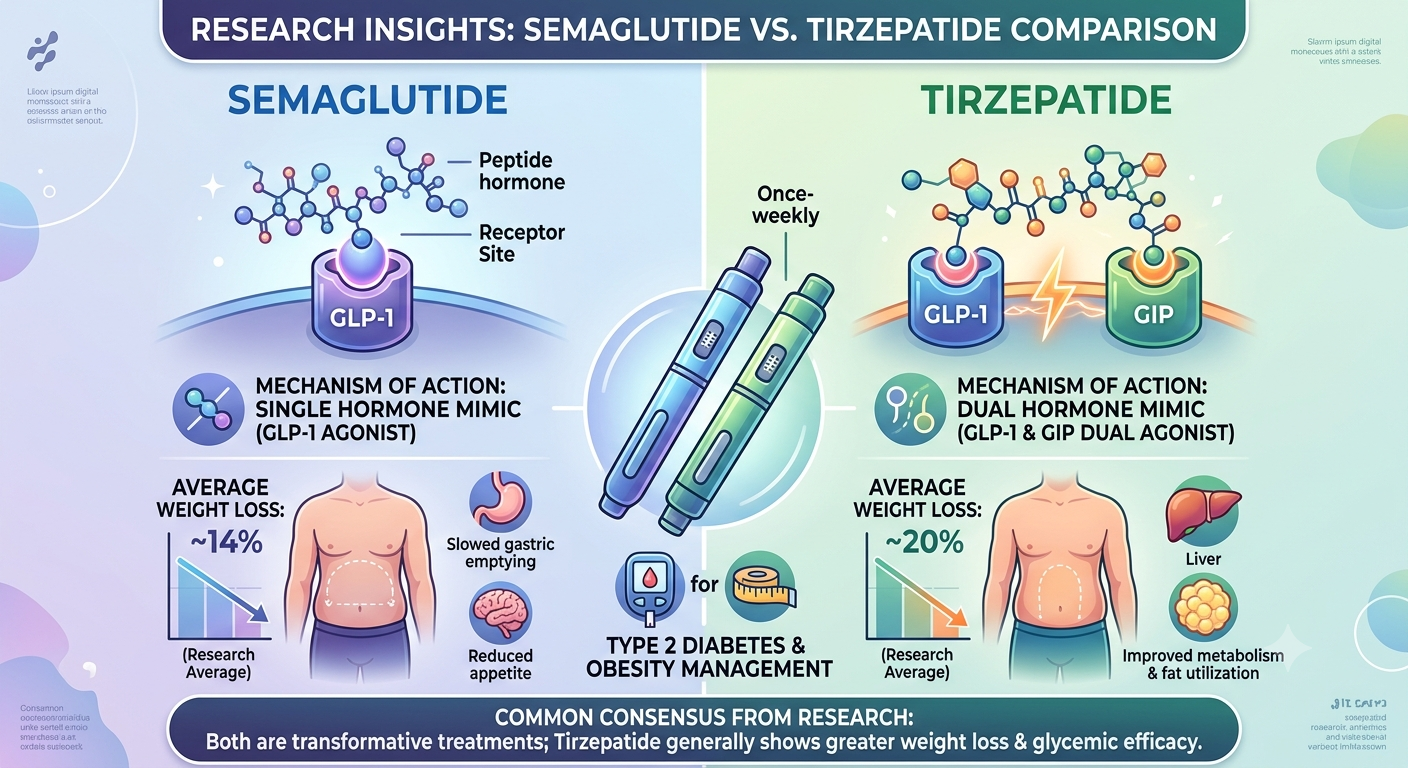
Semaglutide (brand names include Ozempic, Wegovy, and Rybelsus) is a GLP-1 receptor agonist. It mimics a single hormone called glucagon-like peptide-1 (GLP-1). When you eat, GLP-1 triggers insulin production, slows stomach emptying, and sends signals to your brain that you are full.
Tirzepatide (brand names include Mounjaro and Zepbound) is a dual agonist. It mimics not one but two hormones: GLP-1 and another hormone called glucose-dependent insulinotropic polypeptide (GIP). This dual action is what sets tirzepatide apart and is believed to contribute to its superior effectiveness.
Both medications are administered as once-weekly subcutaneous injections and are approved by the FDA for type 2 diabetes and weight management.
Which Is More Effective for Weight Loss?
The research is clear: tirzepatide consistently leads to greater weight loss than semaglutide.
The landmark SURMOUNT-5 trial, published in the New England Journal of Medicine, was the first head-to-head trial comparing the two medications in adults with obesity but without type 2 diabetes.
After 72 weeks, participants taking tirzepatide lost an average of 20.2% of their body weight, compared to 13.7% for those taking semaglutide. This difference was statistically significant (P<0.001).
The results were equally impressive for waist circumference: tirzepatide led to an average reduction of 18.4 cm, compared to 13.0 cm with semaglutide.
| Metric | Tirzepatide | Semaglutide |
|---|---|---|
| Average weight loss at 72 weeks | 20.2% | 13.7% |
| Average waist circumference reduction | 18.4 cm | 13.0 cm |
| Participants achieving ≥10% weight loss | Significantly more likely | Less likely |
| Participants achieving ≥25% weight loss | ~32% | ~16% |
Nearly one-third (32%) of people who took tirzepatide achieved a body-weight reduction of at least 25%, compared with only 16% of those who received semaglutide. Twice as many people in the tirzepatide group lost at least 25% of their weight compared to the semaglutide group (31.6% vs. 16.1%).
A separate meta-analysis found that tirzepatide was associated with a 4.23% greater weight loss compared to semaglutide, confirming the trend across multiple studies. Another analysis showed that tirzepatide significantly increased the likelihood of achieving ≥10% weight loss compared to semaglutide (RR = 1.72; P < 0.001).
What About Prediabetes?
For individuals with obesity and prediabetes, the benefits of tirzepatide may be even more significant. A post-hoc analysis of the SURMOUNT-5 trial found that 89.9% of participants treated with tirzepatide reverted to normoglycemia (normal blood sugar levels), compared to only 76.2% with semaglutide.
Tirzepatide also led to a greater reduction in HbA1c (-0.60% vs. -0.48%) and a greater mean percent body weight reduction (-21.5% vs. -14.5%) in this subgroup.
Which Is Better for Blood Sugar Control?
Both medications are highly effective for lowering blood sugar, but tirzepatide appears to have the edge here as well.
In a real-world study of patients with type 2 diabetes, tirzepatide users reduced their HbA1c by 1.3% and lost 10.2 kg on average, while semaglutide users reduced their HbA1c by 0.9% and lost 6.1 kg.
The SURPASS-2 trial, which compared the two drugs in patients with type 2 diabetes, found that all three tirzepatide doses were superior to semaglutide in reducing HbA1c levels.
Tirzepatide also appears to have favorable effects on cholesterol, increasing good cholesterol (HDL) while reducing bad cholesterol (LDL) and triglycerides.
What About Side Effects?
Both medications are generally well-tolerated, but gastrointestinal side effects are common with both. The most frequently reported side effects include nausea, vomiting, diarrhea, and constipation.
However, there is emerging evidence that tirzepatide may be associated with fewer gastrointestinal side effects than semaglutide.
A letter to the New England Journal of Medicine noted that tirzepatide was associated with fewer gastrointestinal side effects than semaglutide, possibly due to the counterregulatory role of GIP in modulating emetic (vomiting) pathways. This may offer advantages with regard to adherence.
A meta-analysis of two high-quality randomized trials found no significant difference in the incidence of gastrointestinal adverse events between the two agents, suggesting comparable tolerability. However, some studies suggest that while event rates were consistently lower with tirzepatide, time-to-event differences were modest or non-significant for conditions like pancreatitis and SIBO (small intestinal bacterial overgrowth).
One study found that gastrointestinal side effects led to discontinuation in 3% of participants in the tirzepatide group and 6% in the semaglutide group.
Other Safety Considerations
A comprehensive review of post-marketing safety data identified that both drugs have been associated with gastrointestinal issues (nausea, vomiting, pancreatitis, diarrhea) as well as potential effects on bone remodeling, kidney function, and thyroid health.
However, the same review noted that tirzepatide was preferred over single GLP-1 receptor agonists due to less reported side effects and enhanced benefits in promoting bone formation and protective renal effects, particularly in decreasing albuminuria and eGFR slopes.
Another analysis found comparable safety profiles for semaglutide and tirzepatide in terms of acute pancreatitis and gallbladder diseases, but noted an increased risk of acute kidney injury (AKI) for semaglutide users, underscoring the importance of monitoring kidney function in patients on semaglutide.
A large real-world study published in the Annals of Internal Medicine found that semaglutide, tirzepatide, and dulaglutide have similar gastrointestinal safety profiles in clinical settings. This suggests that while tirzepatide may have a slight edge in tolerability, the difference is not dramatic.
How Much Do They Cost?
Cost is a significant consideration for many patients, and neither medication is cheap.
| Medication | List Price (Annual) | Estimated Net Cost (Annual) |
|---|---|---|
| Semaglutide | ~$16,000 | ~$6,830 |
| Tirzepatide | ~$13,000 | ~$7,973 |
The estimated net cost for a year of semaglutide is approximately $6,830**, while tirzepatide costs about **$7,973. Both companies also market their drugs directly to cash-paying patients at reduced prices, with tirzepatide starter doses available for around $299 per month** and additional doses up to **$449 per month.
Cost-effectiveness analyses show that tirzepatide is the most cost-effective option at roughly $53,000 per QALY gained**, followed by injectable semaglutide at **$61,000. However, cost-effectiveness depends on the weight loss target: tirzepatide is more cost-effective for higher weight loss targets (≥30%), while semaglutide is more cost-effective for lower targets (≥10%).
Which One Is Right for You?
The choice between semaglutide and tirzepatide depends on your individual health goals, medical history, and preferences.
Tirzepatide may be the better choice if:
- You want to maximize weight loss
- You have prediabetes or type 2 diabetes
- You are willing to pay a slightly higher cost for potentially greater benefits
Semaglutide may be the better choice if:
- You prefer a medication with a longer track record (it was approved earlier)
- You have concerns about the slightly higher cost of tirzepatide
- You have a history of kidney issues (though both require monitoring)
As Dr. Mir Ali, a bariatric surgeon, told the BMJ: “In general, tirzepatide is more effective. It works on two hormone receptors to suppress the appetite as opposed to semaglutide”.
However, both drugs are highly effective and represent a significant advance in the treatment of obesity and type 2 diabetes.
The Bottom Line
The research is clear: tirzepatide is more effective than semaglutide for weight loss and blood sugar control. In the SURMOUNT-5 trial, tirzepatide led to nearly 50% greater weight loss (20.2% vs. 13.7%) and superior reductions in waist circumference.
Tirzepatide also appears to have a slight edge in tolerability, with some studies suggesting fewer gastrointestinal side effects. However, both medications carry similar gastrointestinal risks, and the difference in side effects is modest.
The choice between these two medications should be made in consultation with a healthcare provider, taking into account your individual health needs, preferences, and financial considerations. Both drugs are transformative treatments that have changed the landscape of obesity and diabetes care—and both represent genuine breakthroughs in medical science.
Disclaimer: This article is for informational purposes only and does not constitute medical advice. Always consult a qualified healthcare professional before starting, stopping, or changing any medication.
Read also



One Comment