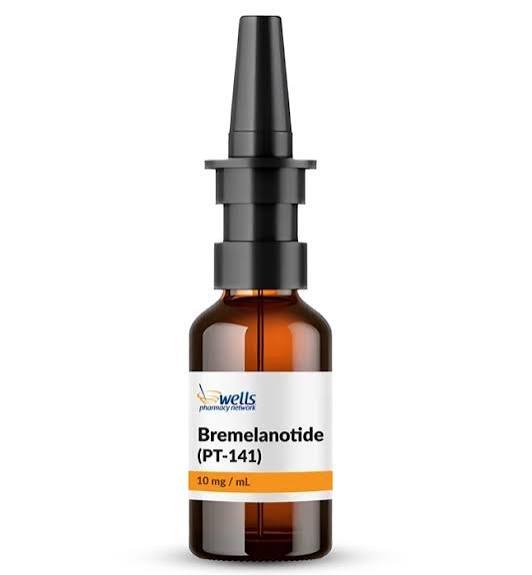
Desire™ (Bremelanotide): A Neutral Review
Desire™ (Bremelanotide) :The only FDA-approved peptide for hypoactive sexual desire disorder (HSDD) in premenopausal women — backed by two Phase 3 trials showing statistically significant improvements in desire and distress, but with a 40% nausea rate, a blood pressure warning, a risk of permanent skin darkening, and a price tag that puts it out of reach for many.
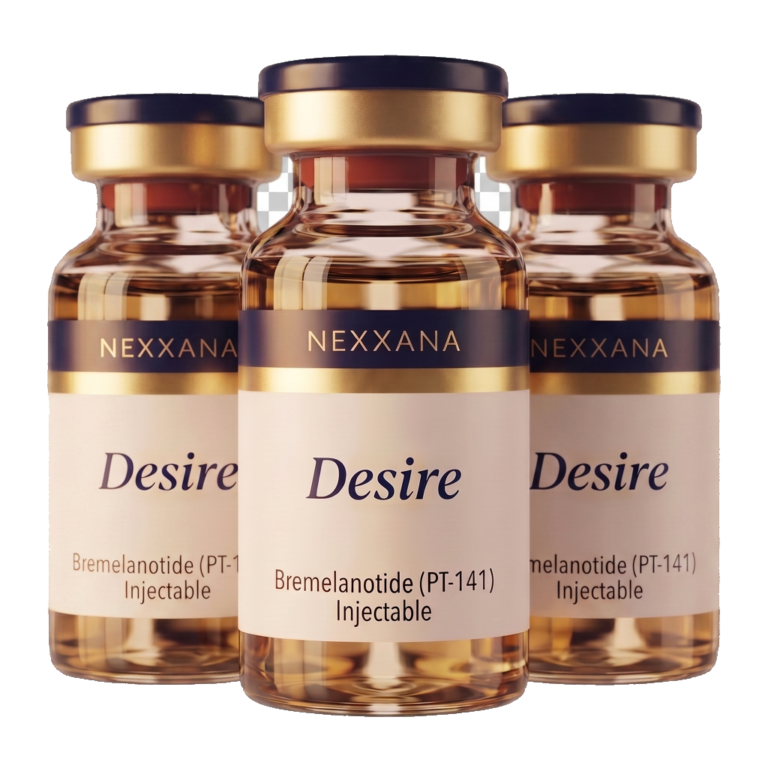
Bremelanotide — sold under the brand name Vyleesi and sometimes referred to as PT-141 — is a melanocortin receptor agonist approved by the FDA in June 2019 for acquired, generalized hypoactive sexual desire disorder in premenopausal women. It is not approved for postmenopausal women or for men, and it is not indicated to enhance sexual performance.
This is a medication that sits at the intersection of legitimate clinical evidence and significant tolerability challenges. Here’s what the research actually shows.
What Is Bremelanotide?
Bremelanotide is a cyclic heptapeptide derived from melanotan-II, originally investigated as a sunless tanning agent. Its sexual effects were discovered incidentally during those early studies — a single injection of melanotan-II induced unexpected erections in male subjects .
It is administered as a subcutaneous injection of 1.75 mg, self-administered via a prefilled autoinjector pen into the abdomen or thigh, at least 45 minutes before anticipated sexual activity .
At a glance:
What the Clinical Trials Show
The evidence base for bremelanotide is built on the RECONNECT trials — two identical Phase 3 randomized, double-blind, placebo-controlled studies involving 1,247 premenopausal women with acquired, generalized HSDD .
The co-primary endpoints were:
- Change in the FSFI Desire domain score (a validated measure of sexual desire)
- Change in FSDS-DAO Question 13 (a measure of distress related to low desire)
The results:
- Bremelanotide showed statistically significant improvements in both desire and distress compared to placebo
- Effect sizes for improving desire ranged from 0.49 to 0.61 (moderate to large), and for reducing distress from 0.60 to 0.62
- Relative to placebo, effect sizes were 0.29–0.43 for desire and 0.26–0.32 for distress
- Treatment effects were noted early and maintained throughout the 24-week double-blind period
For context: An analysis of pharmacologic treatments for generalized anxiety disorder reported effect sizes relative to placebo of 0.36 and 0.38 for SSRIs and benzodiazepines, respectively . Bremelanotide’s effect sizes fall in a comparable range.
A critical caveat: The placebo response rate was approximately 35%, and there was a 25% increase in satisfying sexual events among patients who received placebo — meaning 40% of the relative increase among bremelanotide-treated patients could be attributed to the placebo effect . This is typical of subjective endpoints in sexual dysfunction research.

How It Works
Bremelanotide is a melanocortin-4 receptor (MC4R) agonist . Unlike PDE5 inhibitors, which work peripherally on blood flow, bremelanotide acts centrally on the nervous system to modulate sexual desire and arousal pathways.
A 2022 double-blind, placebo-controlled crossover study using fMRI scanning found that bremelanotide enhanced cerebellar and supplementary motor area activation in response to erotic visual stimuli, deactivated the secondary somatosensory cortex, and increased amygdala-insula functional connectivity . The authors interpreted this as bremelanotide reducing the cognitive-emotional barriers to sexual engagement rather than simply amplifying a peripheral signal .
This mechanism helps explain why it may be effective in women whose low desire is rooted in inhibitory rather than purely physiological factors.
The Side Effects — And They Are Significant
Nausea is the headline. In the Phase 3 trials, nausea was reported in 40% of bremelanotide-treated patients, requiring anti-emetic therapy in 13% and leading to premature discontinuation for 8% . The FDA notes that pre-treatment with ondansetron was not found to be effective and is not recommended; anti-nausea medication may be prescribed for use after nausea occurs .
Other common side effects (incidence > 4%) include flushing, injection site reactions, headache, and vomiting .
Transient blood pressure increase. Bremelanotide induces maximal increases of 6 mmHg systolic and 3 mmHg diastolic, peaking 2–4 hours post-dose, with a corresponding reduction in heart rate up to 5 beats per minute. Blood pressure returns to baseline usually within 12 hours . This effect is why the drug is contraindicated in patients with uncontrolled hypertension or known cardiovascular disease .
Focal hyperpigmentation. In Phase 3 trials, 1% of patients receiving up to 8 doses per month developed darkening of the skin, including the face, gums, and breasts. In a separate study where patients received daily dosing for 8 days, 38% developed focal hyperpigmentation — and among those who continued, an additional 14% developed new pigmentary changes. Resolution was not confirmed in all patients after discontinuation . Patients with darker skin are more likely to develop this.
Discontinuation rule: If no improvement is reported after 8 weeks, treatment should be discontinued .
What Bremelanotide Is Best For — and What It’s Not
Best for: Premenopausal women with acquired, generalized HSDD who have been evaluated and diagnosed by a healthcare provider, who do not have uncontrolled hypertension or cardiovascular disease, and who are willing to tolerate the significant risk of nausea in exchange for a moderate effect on desire and distress.
Not for:
- Postmenopausal women — not indicated and not studied in this population
- Men — not FDA-approved for any male indication, despite early-phase research showing erectogenic effects
- Anyone with uncontrolled hypertension or known cardiovascular disease — contraindicated
- Anyone seeking a daily-use medication — it is as-needed, with a maximum of 8 doses per month
- Anyone who cannot tolerate nausea — 40% of users experience it, and 8% discontinue because of it
Frequently Asked Questions
What is bremelanotide approved for?
Bremelanotide (Vyleesi) is FDA-approved for acquired, generalized hypoactive sexual desire disorder (HSDD) in premenopausal women . It is not approved for postmenopausal women, not approved for men, and not indicated to enhance sexual performance.
How do I use it?
Inject 1.75 mg subcutaneously into the abdomen or thigh, using the autoinjector pen, at least 45 minutes before anticipated sexual activity. Do not use more than one dose in 24 hours or more than 8 doses in a month .
How well does it work?
In Phase 3 trials, bremelanotide showed statistically significant improvements in sexual desire and distress compared to placebo. Effect sizes relative to placebo ranged from 0.29–0.43 for desire and 0.26–0.32 for distress . The placebo response rate was high (~35%), so real-world effects may be smaller.
What are the side effects?
The most common side effects are nausea (40%), flushing, injection site reactions, headache, and vomiting. Bremelanotide also causes transient blood pressure increases and can cause focal hyperpigmentation (skin darkening) that may be permanent .
Is it safe?
Bremelanotide is contraindicated in patients with uncontrolled hypertension or known cardiovascular disease. It should be discontinued after 8 weeks if no improvement is seen. The safety of long-term use beyond the trial periods is not fully established .
How much does it cost?
Vyleesi retails for approximately $900–$1,000 per month without insurance . Most patients in prescribing data had commercial insurance coverage (81%) .
Final Verdict
Bremelanotide is a legitimate, FDA-approved medication with real clinical evidence behind it. The RECONNECT trials were well-designed, and the effect sizes — while moderate — are comparable to other pharmacologic treatments for subjective conditions. For premenopausal women with diagnosed HSDD who have not responded to other approaches, it represents a genuine option.
But the tolerability profile is challenging. A 40% nausea rate is not trivial. The risk of permanent skin darkening, while low at the approved dosing frequency (1%), is real. The blood pressure effects require screening and monitoring. And the cost — nearly $1,000 per month without insurance — puts it out of reach for many.
The honest expectation: This is not a “female Viagra” that works for everyone. It is a targeted treatment for a specific diagnosis, with moderate efficacy and significant side effects. The patient experience is highly individual — some women find the trade-off worthwhile, others do not.
If you’re considering bremelanotide: It requires a prescription and a diagnosis from a healthcare provider. Discuss your cardiovascular risk, your tolerance for nausea, and the hyperpigmentation risk. Understand that it is as-needed, not daily, and that you should discontinue after 8 weeks if you see no improvement.
Disclaimer: The material shared on this page is for general education only and does not replace guidance from a licensed medical professional. Bremelanotide is a prescription medication. The statements on this page have not been evaluated by the Food and Drug Administration for any purpose other than as described in the approved prescribing information. Anyone considering this medication should consult their healthcare provider.