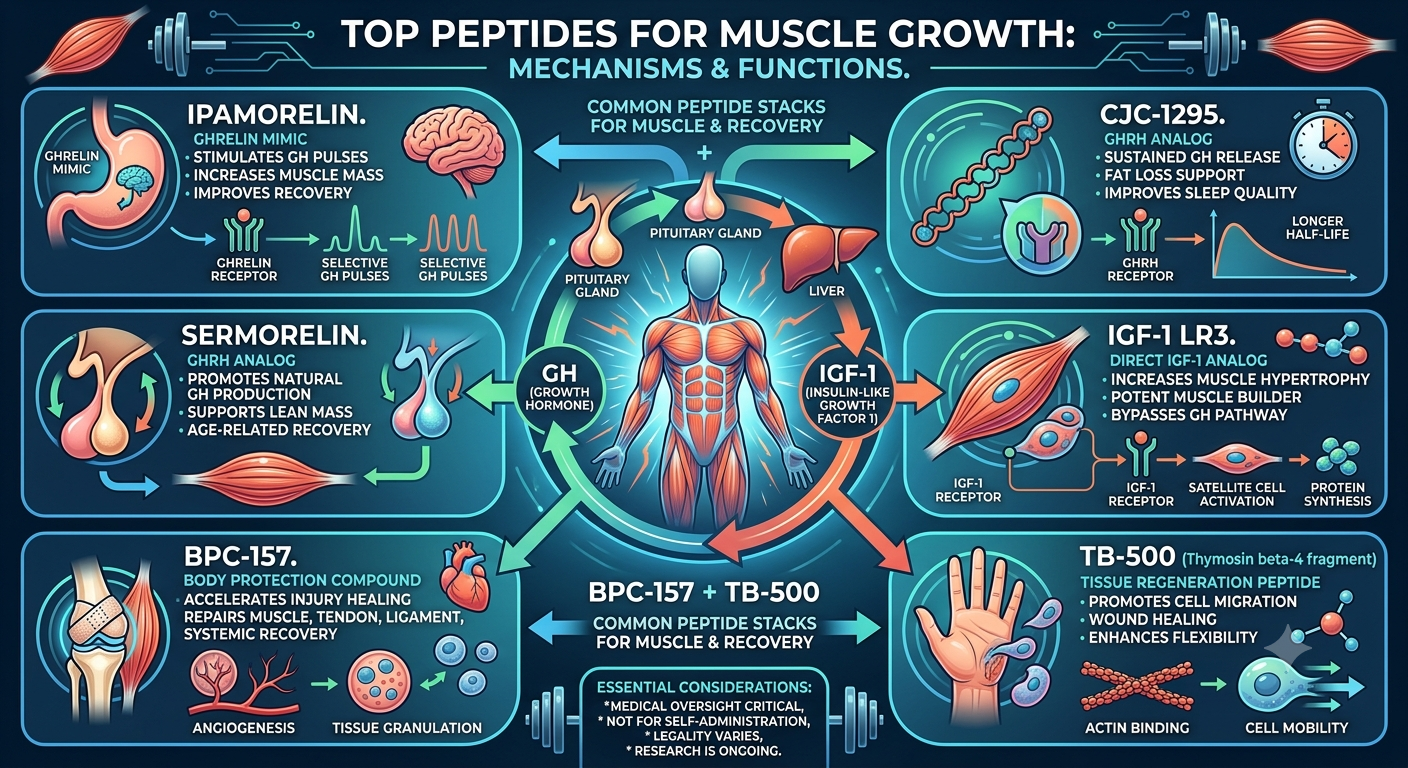
Top Peptides for Muscle Growth: Complete Guide 2026
Top Peptides for Muscle Growth :If you’ve been training hard but feel like you’ve hit a plateau, you’re not alone. Every serious lifter eventually reaches that point where diet and exercise alone aren’t delivering the gains they used to. That’s where peptides come in.
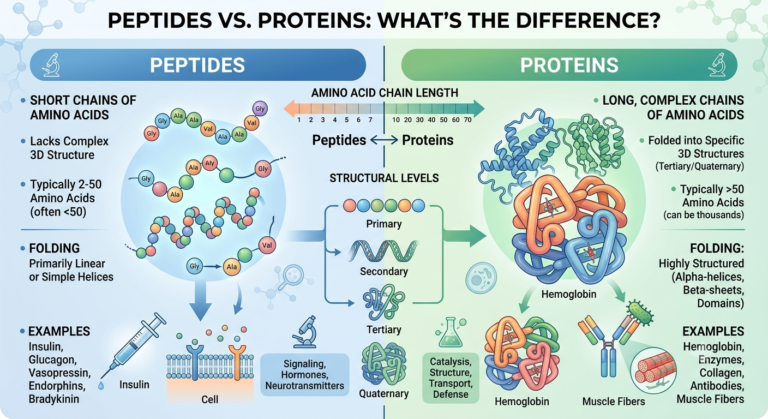
Peptides are short chains of amino acids that act as signaling molecules in the body. In the context of muscle growth, certain peptides can amplify your body’s natural growth hormone production, accelerate recovery, and push muscle growth beyond what you’d achieve naturally.
But not all peptides are created equal. Some are better for lean mass, others for recovery, and a few can genuinely help you exceed your genetic ceiling. This guide breaks down the most effective peptides for muscle growth in 2026, how they work, and how to use them effectively.
How Peptides Work for Muscle Growth
The most effective muscle-building peptides work through two main pathways:
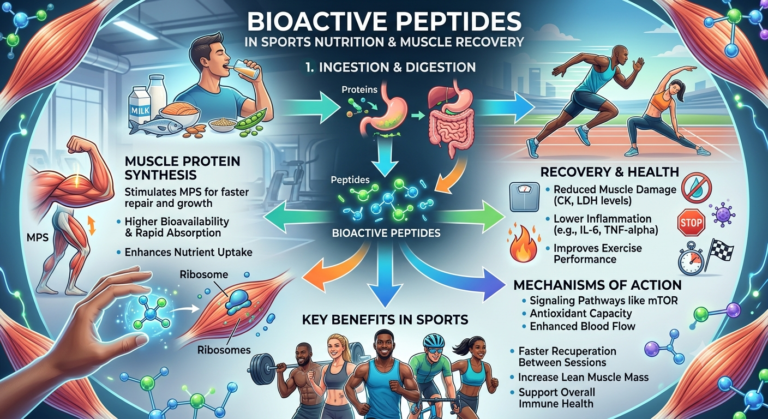
1. Growth Hormone (GH) Secretagogues – These peptides stimulate your pituitary gland to release more of your own growth hormone. This leads to increased IGF-1 production, which drives muscle protein synthesis and recovery.
2. Direct Growth Factors – These peptides bypass the GH pathway entirely and act directly on muscle tissue to stimulate growth.
Understanding which pathway you need is the first step to choosing the right peptide.
The Top Peptides for Muscle Growth
1. Ipamorelin: The Selective GH Releaser
Ipamorelin is widely considered the gold standard starter peptide for muscle growth. It’s a growth hormone secretagogue that triggers your pituitary gland to release GH in a clean, controlled pulse—without the messy side effects that plague older peptides.
What makes Ipamorelin special is its selectivity. It binds to the ghrelin receptor but only activates the GH release pathway. This means you get a meaningful bump in growth hormone—enough to support muscle protein synthesis, fat metabolism, and recovery—without spiking cortisol, prolactin, or appetite.
Key Benefits:
- Clean GH release without significant side effects
- Faster recovery and reduced muscle soreness
- Improved sleep quality
- Pairs perfectly with CJC-1295 for amplified results
Typical Dosage: 100-300 mcg per injection
Half-Life: Approximately 4 hours
Best Used: Before bed or upon waking
2. CJC-1295: Extended GH Elevation
If Ipamorelin is the spark, CJC-1295 is the sustained burn. This modified growth hormone releasing hormone (GHRH) analog extends your body’s GH elevation from hours to days.
CJC-1295 works on a completely different receptor than Ipamorelin—the GHRH receptor rather than the ghrelin receptor. This is why the two compounds synergize so well together. You’re hitting the GH release system from two different angles simultaneously, and the result is significantly greater GH output than either peptide alone.
Key Benefits:
- Sustained GH levels for days (with DAC version)
- Consistent IGF-1 amplification
- Less frequent dosing required
- Synergistic with Ipamorelin
Typical Dosage: 1-2 mg per week (with DAC)
Half-Life: Approximately 8 days (with DAC)
Receptor Type: GHRH
3. GHRP-2 and GHRP-6: The Original GH Peptides
Before Ipamorelin existed, GHRP-2 and GHRP-6 were the go-to growth hormone releasing peptides. They’re still powerful tools—arguably producing a stronger acute GH spike than Ipamorelin—but they come with more side effects.
GHRP-6 is known for causing intense hunger spikes within 20 minutes of injection, which can actually be useful if you’re trying to eat in a surplus for a bulking phase.
GHRP-2 is slightly more selective—less appetite stimulation than GHRP-6 but still more than Ipamorelin. Both can elevate cortisol and prolactin at higher doses, which is the main reason many users have migrated to Ipamorelin.
Key Benefits:
- Stronger acute GH pulse
- Appetite boost (especially GHRP-6)
- Cost-effective option
Typical Dosage: 100-300 mcg per injection
Half-Life: Approximately 3 hours
4. IGF-1 LR3: The Direct Muscle Growth Factor
Every GH secretagogue ultimately works by increasing IGF-1 levels. IGF-1 LR3 skips the middleman entirely. This is a modified version of insulin-like growth factor 1 with an extended half-life, and it acts directly on muscle tissue to drive growth.
What makes IGF-1 LR3 particularly interesting is that it activates satellite cells—the stem cells of muscle tissue. When satellite cells are activated, they fuse with existing muscle fibers and donate their nuclei. More nuclei means a muscle fiber can sustain more protein and grow larger. This is a fundamentally different growth mechanism than what you get from GH alone.
Key Benefits:
- Direct muscle action bypassing the GH pathway
- Satellite cell activation for long-term growth
- Extended activity (20-30 hours)
- Dual anabolic effect: building more while losing less
Typical Dosage: 20-50 mcg per injection
Half-Life: 20-30 hours
Distribution: Systemic
5. IGF-1 DES: Localized Muscle Growth
IGF-1 DES is the short-acting, site-specific cousin of IGF-1 LR3. Where LR3 circulates systemically and affects all muscle tissue equally, DES is designed for targeted injection directly into the muscle you want to grow. It has a very short half-life—roughly 20-30 minutes—which means its effects are concentrated right where you inject it.
This makes IGF-1 DES the peptide of choice for bringing up lagging body parts. Weak calves? Stubborn shoulders? By injecting DES directly into the target muscle post-workout, you’re concentrating the growth signal exactly where it’s needed most.
Key Benefits:
- Site-specific growth in targeted muscles
- 10x higher affinity for the IGF-1 receptor than IGF-1
- Best administered immediately post-workout
- Potent anabolic signal
Typical Dosage: 50-150 mcg per injection
Half-Life: 20-30 minutes
Distribution: Localized
6. Follistatin 344: The Myostatin Blocker
Follistatin 344 operates on a completely different principle than every other peptide on this list. Instead of adding a growth signal, it removes a growth limiter.
Myostatin is a protein your body produces specifically to cap muscle growth—it’s the genetic governor that prevents your muscles from growing beyond a certain point. Follistatin binds to myostatin and neutralizes it, effectively raising (or removing) your genetic muscle ceiling.
This is why Follistatin gets so much attention. Every other peptide helps you grow within your genetic potential. Follistatin potentially lets you exceed it.
Key Benefits:
- Direct myostatin inhibition
- Potential to exceed genetic limits
- Works independently from GH/IGF-1 pathways
- Shifts the goalposts over weeks
Typical Dosage: 100 mcg per day
Cycle Length: 10-30 days
Half-Life: Variable
7. MK-677 (Ibutamoren): The Oral GH Secretagogue
MK-677 is technically not a peptide—it’s a non-peptide ghrelin receptor agonist. But it makes this list because it does exactly what the best GH peptides do (stimulate growth hormone release) with one massive advantage: you take it as a pill. No injections, no reconstitution, no refrigeration. Just swallow a capsule and your GH levels rise significantly for the next 24 hours.
MK-677 has been extensively studied and consistently shows increases in GH and IGF-1 levels comparable to injectable GH secretagogues. It’s particularly popular for long-term use because the oral route makes daily compliance effortless.
Key Benefits:
- Oral dosing—no injections required
- 24-hour GH elevation from a single daily dose
- Improved sleep quality
- Increased IGF-1 levels by 39-89%
Typical Dosage: 10-25 mg per day
Half-Life: Approximately 24 hours
Administration: Oral
Proven Stacking Strategies
Individual peptides are effective, but strategic stacking is where the real results happen. By combining compounds that work through different mechanisms, you can amplify muscle growth beyond what any single peptide achieves.
Stack 1: CJC-1295 + Ipamorelin (Most Popular)
This is the entry-level stack that most people start with, and many never move beyond it because the results are that good. CJC-1295 (GHRH receptor) + Ipamorelin (ghrelin receptor) creates a synergistic GH release that’s 2-3x greater than either compound alone.
Protocol: Inject both peptides subcutaneously before bed. The CJC provides sustained elevation while the Ipamorelin triggers a strong acute pulse—especially during sleep when GH release is naturally highest.
Expected Results:
- Improved recovery within 1-2 weeks
- Body composition changes by week 4-6
- Meaningful lean mass gains by the end of a 12-week cycle
Stack 2: MK-677 + IGF-1 LR3 (Advanced)
This is the “growth at all costs” stack for experienced users. MK-677 provides sustained, oral-dosed GH elevation (keeping IGF-1 levels high 24/7) while IGF-1 LR3 delivers direct growth factor stimulation to muscle tissue.
Protocol: MK-677 daily + IGF-1 LR3 2-3 times per week.
Important Considerations:
- IGF-1 LR3 has insulin-like effects and can cause hypoglycemia—manage with adequate carbohydrate intake
- MK-677’s appetite increase helps with consuming the surplus calories needed for this level of anabolic signaling
Stack 3: Recovery-Enhanced (Add BPC-157)
Any of the above stacks can be enhanced by adding BPC-157 for accelerated tissue repair. BPC-157 doesn’t directly build muscle, but it dramatically speeds recovery from training-induced damage, reduces joint and tendon inflammation, and improves gut health (which means better nutrient absorption).
Protocol: BPC-157 at 250-500 mcg daily alongside any GH secretagogue stack.
Important Considerations
The 80/20 Rule
Peptides are the 20% that amplifies the 80%. If your training, nutrition, and sleep aren’t already producing results, adding peptides won’t fix that. Get the basics right first, then use peptides to push beyond what the basics can achieve.
Diet Must Support Growth
You cannot build muscle in a caloric deficit, no matter how many peptides you take. GH secretagogues and IGF-1 can improve nutrient partitioning (more calories going to muscle, fewer to fat), but they can’t create mass from nothing.
Minimum Requirements:
- Caloric surplus of at least 300-500 calories above maintenance
- Protein intake at 1g per pound of bodyweight
- Peptides make your surplus more efficient—they don’t replace it
Training Is Non-Negotiable
Peptides enhance your body’s response to the training stimulus. Without a progressive overload program that’s actually challenging your muscles, there’s nothing to enhance.
Requirements:
- Structured training 4-5 days per week
- Tracked progression
- Enhanced recovery means you can handle more volume and frequency than natural—take advantage of that
Cycling Matters
Most GH secretagogues should be cycled—typically 8-12 weeks on, 4 weeks off—to prevent receptor desensitization.
Cycle Guidelines:
- GH Secretagogues: 8-12 weeks on, 4 weeks off
- MK-677: Can be run longer, but periodic breaks help maintain sensitivity
- IGF-1 Variants: 4-6 weeks on, 4 weeks off
- Follistatin: Short cycles—typically 10-30 days
Start With One Compound
If you’re new to peptides, don’t start with a complex five-compound stack. Begin with a single GH secretagogue (Ipamorelin is ideal) or the basic CJC-1295 + Ipamorelin stack. Run it for a full cycle, assess your response, and then decide whether to add more compounds.
Frequently Asked Questions
What are the best peptides for beginners looking to build muscle?
The CJC-1295 + Ipamorelin stack is the best starting point for muscle growth. It’s the most well-studied combination, has the fewest side effects, and produces reliable results in virtually everyone. Start with standard doses (Ipamorelin 200mcg + CJC-1295 without DAC 100mcg, injected before bed) and run a 12-week cycle before considering adding anything else.
How long does it take to see muscle growth results from peptides?
Most users notice improved recovery and sleep quality within the first 1-2 weeks. Visible body composition changes typically appear by weeks 4-6. Measurable lean mass gains usually require a full 8-12 week cycle.
Can you use muscle-building peptides while cutting?
Yes—and they’re actually excellent for it. GH secretagogues like Ipamorelin and CJC-1295 improve nutrient partitioning, meaning more of your calories go to muscle preservation and more stored fat gets mobilized for energy. You won’t build significant new muscle in a deficit, but peptides can dramatically reduce muscle loss during a cut.
Are peptides safer than traditional HGH injections?
GH secretagogues work by stimulating your body’s own GH production rather than injecting exogenous hormone. This means your pituitary maintains its natural pulsatile release pattern, negative feedback loops stay intact, and the risk of side effects is significantly lower than with pharmaceutical HGH.
Do I need PCT (post-cycle therapy) after a peptide cycle?
GH secretagogues don’t suppress your natural testosterone production, so traditional PCT isn’t necessary. Your GH production may temporarily decrease when you stop, but it recovers on its own within 2-4 weeks. That said, taking 4 weeks off between cycles helps restore receptor sensitivity.
Conclusion
The peptide landscape for muscle growth in 2026 offers more options than ever. From the clean, beginner-friendly GH release of Ipamorelin and CJC-1295, to the direct muscle-building power of IGF-1 LR3 and IGF-1 DES, to the genetic-ceiling-breaking potential of Follistatin 344, and the effortless oral dosing of MK-677—there’s a peptide for every goal and experience level.
Start simple. The CJC-1295 + Ipamorelin stack remains the single best entry point for anyone new to peptides. Master the basics, dial in your nutrition and training to take advantage of enhanced recovery, and then expand your protocol as your experience and goals evolve.
Remember: Peptides are powerful tools, but they’re not magic. They amplify the results of what you’re already doing—which means the fundamentals have to be dialed in or you’re wasting your money.
Disclaimer: This article is for informational and educational purposes only and does not constitute medical advice. Peptides are biologically active compounds that can affect your hormonal system. Consult with a qualified healthcare provider before starting any peptide protocol. Individual responses vary based on genetics, health status, and other factors.
Read also
2 Comments