Thymosin Alpha-1 vs Thymosin Beta-4: Immune Support vs Tissue Repair (2026)
Thymosin Alpha-1 vs Thymosin Beta-4 :If you have been researching peptide therapies, you have likely come across two names that appear frequently: Thymosin Alpha-1 and Thymosin Beta-4. Often mentioned together, they are actually quite different in what they do. One is primarily an immune modulator. The other is a tissue repair agent. Understanding the distinction is essential for deciding which aligns with your health goals.
Here is a clear breakdown of how they compare, what each one does, and why they are often discussed together despite serving different functions.
Where Do These Peptides Come From?
Both Thymosin Alpha-1 (Tα1) and Thymosin Beta-4 (Tβ4) are naturally occurring peptides originally derived from the thymus gland—a small organ located behind the breastbone that plays a central role in immune system development .
The thymus is most active during childhood and adolescence. As we age, it gradually shrinks (a process called involution) and produces fewer of these peptides, which contributes to declining immune function and slower recovery over time . This is a key reason why researchers have studied these peptides for therapeutic use.
Important note: The name “thymosin” does not imply a shared structure or mechanism. These peptides were grouped together because they were isolated from the same tissue extract—not because they function similarly.
Structural and Biochemical Differences
The structural distinction between these two peptides is fundamental to their different functions.
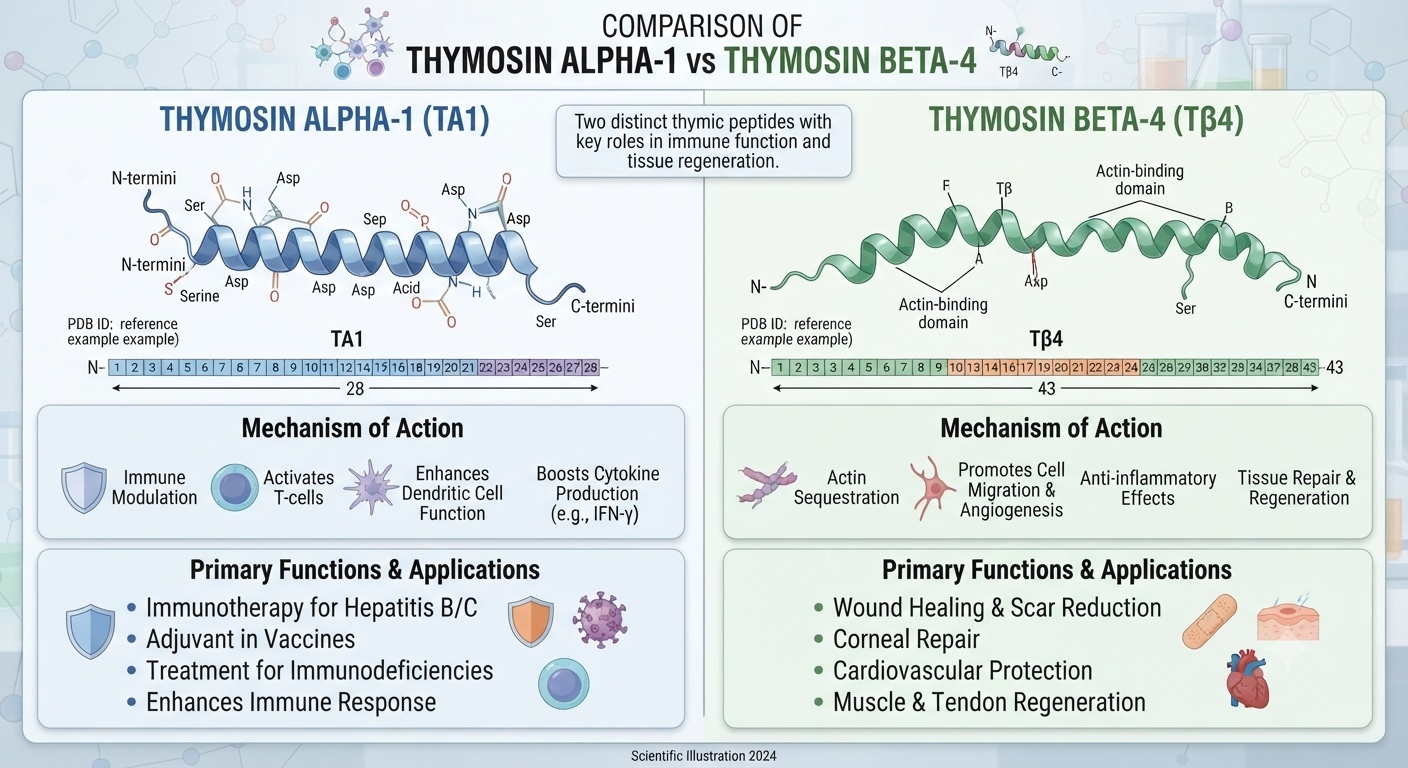
| Feature | Thymosin Alpha-1 | Thymosin Beta-4 |
|---|---|---|
| Amino Acids | 28 | 43 |
| Molecular Weight | 3,108 Da | ~4,982 Da |
| Primary Function | Immune regulation | Tissue repair and regeneration |
| Mechanism | Activates T-cells, modulates cytokines | Promotes actin polymerization, angiogenesis |
Thymosin Alpha-1 is a 28-amino acid peptide, while Thymosin Beta-4 contains 43 amino acids . Both have their N-terminal amino acid residue blocked by an acetyl group, but their primary sequences show no homology with each other .
The scientific literature confirms that Tα1 and Tβ4 are “chemically distinct and differ in their immunological activity profiles” . This structural difference correlates with their divergent biological actions.
Thymosin Alpha-1: The Immune System Regulator
Thymosin Alpha-1 is best known for its role as an immune system regulator . It does not stimulate the immune system broadly; rather, research suggests it helps the immune system respond more efficiently and appropriately to threats .
How Does It Work?
Tα1 acts as a biological response modifier. It stimulates the production and activity of T-cells—specialized white blood cells responsible for identifying and attacking viruses, bacteria, and abnormal cells .
At the molecular level, Tα1 works through several pathways:
- Toll-like receptor activation: Tα1 has been shown to be a TLR-9 and TLR-2 agonist, affecting multiple immune cell subsets
- Dendritic cell activation: It activates both myeloid and plasmacytoid dendritic cells, leading to the production of immune-related cytokines
- T-cell maturation: It enhances the maturation and function of T-cells
Tα1 also interacts with Galectin-1, a protein involved in immunoregulation, infections, and cancer progression. This interaction inhibits Galectin-1 dependent cancer cell migration and endothelial cell tubular structure formation .
Key Functions
Research indicates Tα1 helps with:
- Enhancing T-cell maturation and function
- Supporting the body’s defense against viral and bacterial infections
- Modulating immune responses to reduce chronic inflammation
- Promoting balance between pro-inflammatory and anti-inflammatory pathways
- Supporting immune recovery after illness or physical stress
Clinical Research
Thymosin Alpha-1 has been studied extensively in clinical research worldwide. It has been approved in over 35 countries for specific medical applications, including chronic hepatitis B and C, and as an immune adjunct in cancer patients . It is not FDA-approved in the United States.
The strongest clinical evidence supports its use in chronic hepatitis B and as an adjuvant for immune enhancement . Ongoing research continues to examine its broader applications in immune support and wellness optimization .
Thymosin Beta-4: The Tissue Repair Peptide
Thymosin Beta-4 is known primarily for its role in tissue repair, wound healing, and reducing inflammation . It is found in nearly every cell and tissue in the body .
How Does It Work?
Tβ4 works at the cellular level to support healing. It promotes several key processes:
- Actin binding: Tβ4 is the major G-actin-sequestering molecule in mammalian cells. It binds to monomeric actin and inhibits its polymerization .
- Cell migration: It promotes the migration of cells to injury sites .
- Angiogenesis: It promotes the formation of new blood vessels, crucial for delivering oxygen and nutrients to healing tissues .
- Anti-inflammatory effects: It reduces inflammation at injury sites .
Thymosin Beta 4 induces the expression of terminal deoxynucleotidyltransferase in bone marrow cells and acts on lymphoid stem cells in the early maturation process of thymus-dependent lymphocytes .
Key Functions
Published research associates Tβ4 with:
- Accelerating wound healing and tissue repair
- Reducing inflammation at injury sites
- Promoting blood vessel formation to damaged areas
- Supporting muscle, tendon, and ligament recovery
- Helping reduce scar tissue formation during healing
- Enhancing cell migration to injury sites
Research has demonstrated that Tβ4-treated wounds heal with minimal scarring and without loss in wound breaking strength . The treated wounds had superior organized collagen fibers consistent with mature connective tissue .
Clinical Research
Tβ4 is more commonly used for injury recovery, post-surgery healing, and chronic inflammatory conditions . It has been studied in clinical trials for dermal wounds, corneal repair, cardiac repair, and ophthalmic applications .
Tβ4 has become popular among athletes and active individuals looking to speed up recovery from injuries . It has been shown to accelerate corneal epithelial healing and reduce inflammation after injury .
At a Glance: Key Differences
Can You Use Them Together?
While they serve different primary functions, Tα1 and Tβ4 can be used together for a more comprehensive approach to healing .
Example applications:
- An athlete recovering from an injury might use Tβ4 to accelerate tissue healing while using Tα1 to boost immune function and prevent infections during recovery .
- Someone with an autoimmune condition might benefit from Tα1 to regulate their immune system and reduce inflammation, while Tβ4 helps repair damaged tissues caused by chronic inflammation .
This dual approach is sometimes described as addressing two sides of the recovery equation: immune balance and tissue repair . Emerging research continues to examine combination applications .
Regulatory Status in the United States
As of 2026:
- Thymosin Alpha-1 is not FDA-approved in the United States .
- Thymosin Beta-4 (including TB-500) has undergone regulatory review, and its legal status for compounded use has been subject to ongoing evaluation.
Important: No thymosin family member is FDA-approved for human use in the United States as of 2026 . Always consult a qualified healthcare provider before considering any peptide therapy. Peptides are research chemicals and are not approved for human consumption in many jurisdictions .
Bottom Line
Thymosin Alpha-1 and Thymosin Beta-4 are both powerful peptides, but they serve different primary functions:
- Choose Thymosin Alpha-1 if you are looking for immune system support, infection control, or immune balance. It is the better option for individuals with weakened immunity, chronic infections, or autoimmune conditions .
- Choose Thymosin Beta-4 if you are focused on tissue repair, wound healing, injury recovery, or reducing inflammation. It is the better option for athletes, post-surgery patients, and individuals with chronic injuries .
- Consider combining them if you need comprehensive support for both immune health and tissue repair .
Disclaimer: This article is for informational purposes only and does not constitute medical advice. Always consult a qualified healthcare professional before considering any peptide therapy. Peptides are research chemicals and are not approved for human consumption in many jurisdictions.