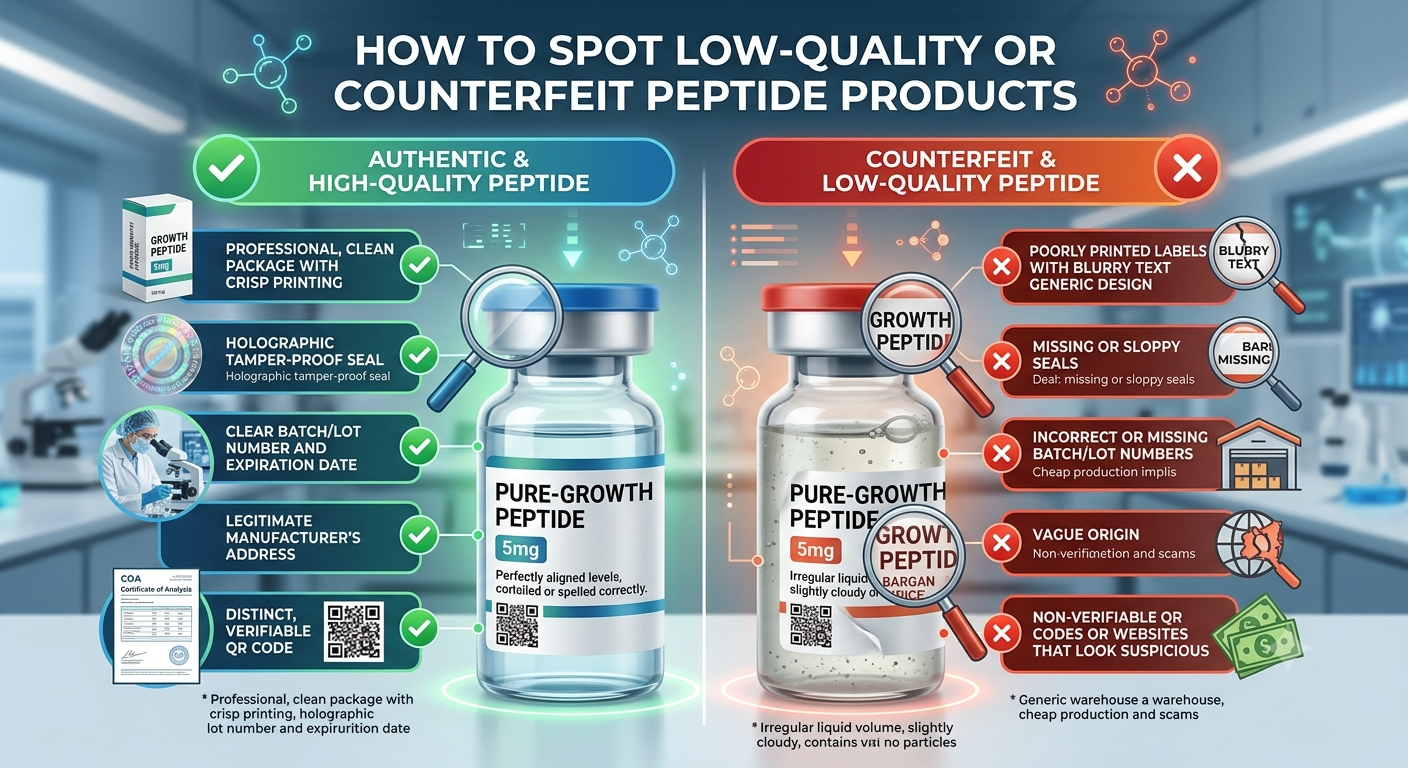
How to Spot Low-Quality or Counterfeit Peptide Products
The peptide market has become one of the fastest-growing and least regulated corners of the wellness industry. Products marketed for weight loss, anti-aging, injury recovery, and cognitive enhancement are now sold openly through social media, direct-to-consumer websites, and gray-market “research chemical” storefronts. The problem is not that peptides are inherently dangerous. The problem is that a parallel market has emerged where the product in the vial frequently does not match the label — and where the consequences can be life-threatening.
This guide explains exactly how to identify low-quality or counterfeit peptide products, what legitimate quality assurance looks like, and what to do if you have already been harmed.
At a Glance
| Category | Key Point |
|---|---|
| Core risk | Counterfeit peptides have contained insulin, caused acute liver injury, and triggered hospitalizations |
| Most common red flag | “For research use only” labels paired with dosing instructions |
| Most important quality document | Third-party Certificate of Analysis (COA) |
| Quality variability found in testing | Up to 78% variability in peptide content between batches |
| Contaminants found in tested samples | Residual solvents (tetrahydrofuran/THF) detected in every sample tested |
| Regulatory status | Most peptides sold online are unapproved and unauthorized for human use |
| Bottom line | If you cannot verify the seller, the COA, and the product identity, do not inject it |
Why Counterfeit Peptides Are Genuinely Dangerous
The risks associated with unregulated peptides are not hypothetical. Regulatory agencies across multiple countries have documented serious harms, including cases where the product contained an entirely different drug than what was on the label.
The Insulin-Containing “Tirzepatide” Pens
In late 2025, Ireland’s Health Products Regulatory Authority (HPRA) detained a consignment of counterfeit tirzepatide injection pens. Laboratory analysis revealed that two of the pens contained insulin instead of tirzepatide.
For a person without diabetes, injecting insulin can cause severe hypoglycemia — a rapid and potentially life-threatening drop in blood sugar that can lead to loss of consciousness, seizures, brain injury, or death if not treated immediately. The person using that pen would have had no reason to suspect the product was anything other than what the label claimed.
This is the defining feature of the counterfeit peptide problem: the danger is not limited to the peptide being weak or impure. The danger is that the contents may be something else entirely.
Documented Hospitalizations and Liver Injury
Australia’s Therapeutic Goods Administration (TGA) and the Chief Medical Officer have reported hospitalizations resulting from severe adverse effects linked to unapproved peptides. These documented harms include:
- Liver damage
- Severe allergic reactions requiring hospitalization
- Inflammation
- Other serious health complications
In Victoria alone, there were six documented cases of acute liver injury associated with unapproved retatrutide products.
These are not reports of mild nausea or a product that failed to deliver results. These are reports of people who required hospital care after using a product they were told was safe.
Part One: The Red Flags of a Sketchy Seller
The majority of dangerous peptide products share a recognizable set of warning signs. Learning to identify them is the single most effective protection available.
Red Flag 1: The “For Research Use Only” Loophole
This is the most common and most consequential red flag in the entire category.
Sellers attempting to avoid regulatory scrutiny label their products with phrases such as:
- “For research purposes only”
- “Not for human consumption”
- “For laboratory use only”
The US Food and Drug Administration has warned about companies selling unapproved drugs falsely labeled this way while simultaneously providing dosing instructions and selling directly to consumers for human use.
The contradiction is the tell. If a product is genuinely sold for laboratory research, it does not come with a dosage chart. It does not come with injection instructions. It is not sold in a vial sized for a single human dose. It is not marketed to fitness enthusiasts.
The rule: If a product is labeled “not for human consumption” but is sold by the milligram in vials alongside injection instructions and dosing guidance, the seller is using a legal loophole to avoid regulation — not protecting your safety.
Red Flag 2: Unrealistic or Sensational Claims
Legitimate therapeutic peptides are studied carefully. Their effects are measured over weeks and months in controlled trials, and their results are modest, incremental, and variable between individuals.
Sellers of counterfeit or low-quality products tend to promise:
- Immediate results
- Guaranteed outcomes
- Dramatic transformations within days
- Effects that “doctors don’t want you to know about”
None of this reflects how peptides actually work. When a seller describes results as certain, fast, and dramatic, the marketing is doing the work that clinical evidence should be doing.
Red Flag 3: Lack of Transparency
Legitimate suppliers are transparent by necessity. Sketchy sellers are opaque by design. Look for the absence of the following:
| What should be present | What its absence suggests |
|---|---|
| Certificate of Analysis (COA) from an independent third-party lab | Product identity and purity are unverified |
| Clear business name, physical address, and contact details | Seller is hiding ownership or does not exist as a real business |
| Drug Identification Number (DIN), Natural Product Number (NPN), or DIN-HM in Canada, or equivalent national authorization | Product is not authorized for sale in your country |
| Lot number, expiry date, and net peptide weight on the label | No traceability and no way to verify stability |
| Established domain history and track record | Seller may be operating a disposable site to outrun bad reviews |
The disappearing website problem: Many sketchy sellers operate through newly registered domains specifically so they can abandon them once complaints accumulate and start fresh under a new name. If the company has no verifiable history, that history is not missing by accident.
Red Flag 4: Pricing That Is “Too Good to Be True”
Synthetic peptide manufacturing is genuinely expensive. It requires:
- Solid-phase peptide synthesis equipment
- High-purity reagents and solvents
- Lyophilization (freeze-drying) capacity
- Independent analytical testing
- Cold-chain shipping and storage
These costs do not disappear at scale. When a price is dramatically below market averages, the seller has almost certainly cut one of the steps that makes the product safe — sourcing from an unverified foreign supplier, skipping third-party testing, or manufacturing with cheap, untested materials.
A bargain price on a peptide is not a bargain. It is a signal that a quality-control step was removed.
Red Flag 5: Pressure-Based Sales Tactics
Scam sales funnels rely on manufactured urgency. Common tactics include:
- Countdown timers
- “Limited stock” or “only 3 vials left” warnings
- Aggressive limited-time discounts
- Pop-ups demanding immediate action
Legitimate retailers do not need to manufacture false urgency. A real supplier with a real product can sell it tomorrow.
Red Flag 6: Social Media Hype as Substitutes for Evidence
Fitness influencers and online testimonials can be powerful marketing tools, and many of them carry financial incentives to promote products they have not verified.
Independent testing has found that even the most popular and “reliable-looking” internet peptide vendors produced products with significant quality issues, including very high variability in the amount of peptide between batches — up to 78% variability.
That number matters. A 78% variability means the same product from the same seller can contain substantially different amounts of the active peptide from one batch to the next. A user following the same protocol could receive a materially different dose each time.
Social media validation is not laboratory testing. A thousand five-star reviews do not confirm peptide identity, purity, or sterility.
Part Two: What Quality Actually Looks Like
The opposite of a red flag is a verifiable quality signal. These are the hallmarks of a legitimate supplier.
Signal 1: Third-Party Testing and a Real Certificate of Analysis
A legitimate supplier provides a Certificate of Analysis (COA) from an independent, third-party laboratory — not from the seller’s own in-house lab, and not a document generated by the seller itself.
A meaningful COA should document the following:
| Test | What it verifies |
|---|---|
| Mass Spectrometry (MS) | Confirms the peptide has the correct molecular weight and amino acid sequence |
| High-Performance Liquid Chromatography (HPLC) | Measures purity as a percentage (e.g., >98%) and detects synthesis impurities |
| Amino Acid Analysis (AAA) | Measures the absolute amount of peptide present and confirms the correct amino acid ratio |
| Residual solvent testing | Confirms no harmful solvent residues remain |
| Heavy metal testing | Confirms absence of toxic metals |
| Sterility testing | Confirms the product is free from microbial contamination |
What HPLC purity actually detects: The impurities found in poorly made peptides are not harmless filler. They include:
- Truncated sequences — peptides missing one or more amino acids
- Deletions — peptides missing an internal amino acid
- Insertions — peptides with an extra amino acid
- Modified sequences — peptides with unintended chemical changes
These are not inert byproducts. They are different molecules that may interact with the body in unpredictable ways.
What testing has actually found: In one study of internet-purchased peptides, traces of residual solvents such as tetrahydrofuran (THF) were found in every sample tested, although the levels were low. The finding is significant not because the levels were immediately dangerous, but because it demonstrates that unverified products routinely contain substances that should not be present at all.
Signal 2: Clear Ingredient Disclosure and Source Transparency
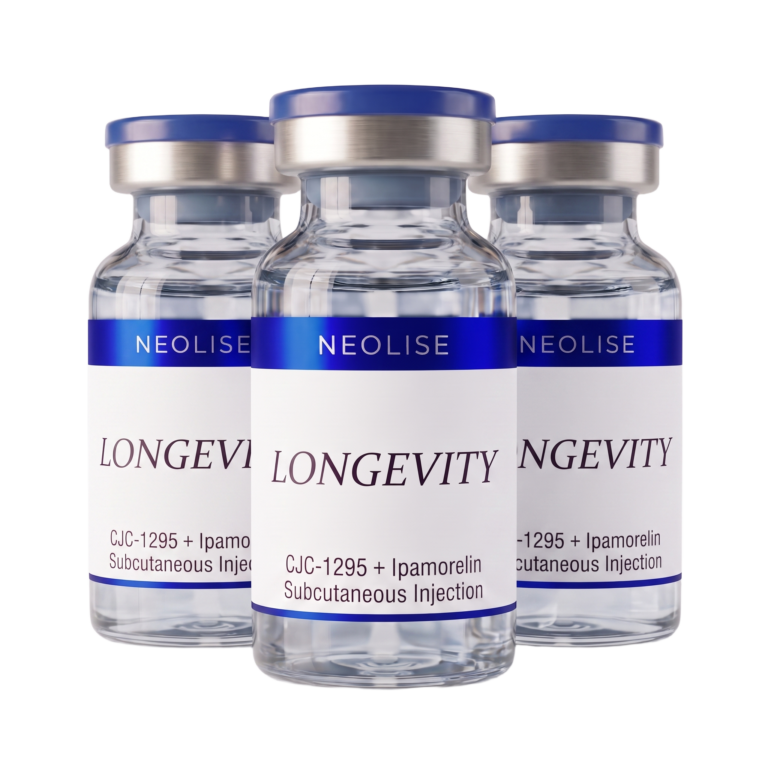
A reputable supplier labels the product clearly and completely. The label should show:
- The exact peptide name (not a vague “peptide complex”)
- The net weight of the peptide — not just the vial size. A 10 mL vial tells you nothing about how much peptide is inside
- The lot number for traceability back to the manufacturing batch
- The expiration date — peptides degrade over time, and an expired product may be ineffective or unsafe
Signal 3: Manufacturer Authentication
Before purchasing, verify the manufacturer through your country’s regulatory database. These include:
- Health Canada’s Drug Product Database
- The FDA’s databases for approved products
- The TGA’s databases in Australia
- The MHRA’s databases in the UK
If the manufacturer does not appear in any authorized product database, the product has not been evaluated for safety, efficacy, or quality by any regulator.
Signal 4: Proper Packaging and Storage
Peptides are fragile molecules. Correct handling is not optional.
| Quality standard | Why it matters |
|---|---|
| Lyophilized (freeze-dried) powder form | Lyophilized peptides are far more stable than liquid solutions |
| Sealed, labeled sterile vial | Prevents contamination and ensures traceability |
| Shipped with a cold pack or in a climate-controlled package | Temperature excursions degrade peptides |
| No liquid peptide solutions sold for long-term storage | Liquid peptide solutions are much less stable and more likely to degrade |
If a supplier ships a liquid peptide solution at ambient temperature with no cold chain, the product may already be degraded by the time it arrives.
Part Three: The Science of Purity Testing, Explained
Understanding what quality testing actually measures helps you evaluate whether a COA is meaningful.
RP-HPLC (Reversed-Phase High-Performance Liquid Chromatography)
This is the industry standard for determining purity. RP-HPLC separates molecules based on their hydrophobicity — how strongly they interact with a nonpolar stationary phase versus a polar mobile phase.
The result is a chromatogram showing peaks for the desired peptide and for any impurities. The percentage of the total area represented by the main peak is reported as purity. A product labeled “>98% pure” means that 98% of the material detected is the intended peptide.
Mass Spectrometry (MS)
MS confirms the peptide’s identity by measuring its molecular weight. Because each peptide has a specific amino acid sequence and therefore a specific mass, MS can verify that the molecule present is the molecule claimed.
MS also detects impurities that HPLC might miss, including modified or truncated sequences that have different masses from the intended peptide.
Amino Acid Analysis (AAA)
AAA measures the absolute amount of peptide in a sample and confirms the correct ratio of amino acids. It is typically used in combination with HPLC and MS to provide a complete picture of peptide identity, purity, and quantity.
What a Complete Testing Panel Looks Like
| Test | What it answers |
|---|---|
| RP-HPLC | Is the peptide pure? |
| MS | Is the peptide the correct molecule? |
| AAA | How much peptide is actually present, and is the amino acid ratio correct? |
| Residual solvent GC | Are harmful solvents present? |
| Heavy metals ICP-MS | Are toxic metals present? |
| Sterility | Is the product free from microbial contamination? |
| Endotoxin | Is the product free from bacterial pyrogens? |
A COA that only reports purity without identity confirmation is incomplete. A COA that reports identity without quantity is incomplete. A complete panel answers all of the above.
Part Four: A Practical Buyer’s Verification Checklist
Before purchasing any peptide product, work through the following steps in order. If any step fails, stop.
Step 1: Verify the Seller Exists as a Real Business
- Does the website have a physical address and working phone number?
- Is the business name registered and verifiable?
- Is ownership information available, or is it hidden behind a privacy service?
- How long has the domain existed?
Step 2: Request the Certificate of Analysis
- Does the seller provide a COA from an independent third-party lab?
- Does the COA include mass spectrometry for identity confirmation?
- Does the COA include HPLC with a stated purity percentage?
- Does the COA include residual solvent and heavy metal testing?
- Does the COA reference the specific lot number of the product you are buying?
If the seller refuses to provide a COA, or provides one that does not include identity testing, the product cannot be verified. Walk away.
Step 3: Inspect the Label Requirements
- Is the exact peptide name stated?
- Is the net peptide weight stated (not just the vial size)?
- Is a lot number present?
- Is an expiration date present?
- Is the product labeled “for research use only” while being sold for human use? If so, treat it as a red flag.
Step 4: Check National Authorization
- Does the product carry a DIN, NPN, or DIN-HM in Canada?
- Is the product authorized in your country’s regulatory database?
- If the product is not authorized anywhere, it has not been evaluated by any regulator for safety or efficacy.
Step 5: Evaluate the Sales Environment
- Are there countdown timers or “limited stock” warnings?
- Are there guaranteed results or immediate-effect claims?
- Is there aggressive pressure to buy now?
- Are there only influencer testimonials and no independent testing data?
Step 6: Assess Packaging and Shipping
- Is the product supplied as lyophilized powder rather than liquid?
- Is it shipped with cold pack or climate control?
- Is the vial sealed, sterile, and labeled?
Step 7: Report Anything Suspicious
If you encounter a seller that fails these checks, consider reporting them to your national health authority. These reports are how regulators identify and shut down dangerous suppliers.
Part Five: What to Do If You Have Already Been Harmed
If you have used an unapproved peptide product and experienced an adverse effect, the following steps matter.
| Step | Action |
|---|---|
| 1 | Stop using the product immediately. Do not finish the vial to “see if it gets better.” |
| 2 | Seek medical care if you experience severe symptoms, including difficulty breathing, chest pain, severe abdominal pain, yellowing of the eyes or skin, dark urine, or signs of hypoglycemia (confusion, shakiness, sweating, rapid heartbeat). |
| 3 | Preserve the product and packaging. Do not discard the vial, the label, or the packaging. These are evidence for both your medical care and any regulatory report. |
| 4 | Document everything. Keep records of the purchase, the seller’s website, the lot number, and your symptoms with dates and times. |
| 5 | Report to your health authority. In the US, report to the FDA’s MedWatch program. In Canada, report to Health Canada. In Australia, report to the TGA. In the UK, report to the MHRA. These reports help regulators identify and shut down dangerous suppliers. |
| 6 | Report to your national consumer protection agency if you believe you were defrauded. |
Reporting adverse events is not a formality. It is how the pattern of harm becomes visible to regulators who can act.
Why the Gray Market Exists
Understanding the market structure helps explain why these risks persist.
Regulatory Ambiguity
Peptides exist in a regulatory gray zone in many countries. Some are approved as prescription drugs for specific indications. Others are not approved at all. The “research chemical” designation allows sellers to market unapproved compounds without triggering drug regulation, provided they do not explicitly claim human use — even when the marketing clearly implies it.
High Margins and Low Barriers
Synthetic peptides are expensive to manufacture correctly and inexpensive to manufacture poorly. The price gap between verified and unverified product is large enough that a seller can undercut legitimate suppliers significantly while maintaining high margins.
Global Supply Chains
Even sellers who believe they are sourcing from a legitimate supplier may be several steps removed from the actual manufacturer. Without independent testing at the point of sale, there is no way to verify what is actually in the vial.
Enforcement Gaps
Regulators act on complaints and on detected consignments. They cannot inspect every website or intercept every shipment. The result is that harmful products can circulate for extended periods before enforcement catches up.
Conclusion: Trust, but Verify — and Verify First
The peptide market is currently a high-risk environment. Buying from an unregulated source does not merely risk a wasted investment. It risks your health, and in documented cases, it has caused hospitalization and acute liver injury.
The safeguards are not complicated, but they require you to be deliberate:
- Verify the seller’s legitimacy through your country’s health regulator
- Demand a Certificate of Analysis from an independent third-party lab, including identity testing
- Treat “research only” labels as a red flag when the product is clearly sold for human use
- Check the label for peptide name, net weight, lot number, and expiration date
- Inspect the packaging to confirm lyophilized powder and cold-chain shipping
- Report adverse events to your health authority so regulators can act
- Walk away from urgency tactics, guaranteed results, and prices that are too low to be real
The science of peptides is genuinely promising. The unregulated market built around them is genuinely dangerous. The difference between the two is verification — and verification is something you can do before you buy, or regret after you inject.
Frequently Asked Questions
Are peptides safe?
Peptides that have been approved by a national regulator and are manufactured under verified quality controls have established safety profiles for their approved indications. Unapproved peptides sold through gray-market channels have no verified safety profile, and testing has shown that they frequently do not match their labels.
What is the biggest warning sign of a counterfeit peptide?
The most common and most consequential warning sign is a “for research use only” or “not for human consumption” label on a product that is sold with dosing instructions and injection guidance. This combination indicates the seller is using a legal loophole rather than complying with drug regulations.
What is a Certificate of Analysis (COA)?
A COA is a document from an independent third-party laboratory that reports the results of analytical testing on a specific batch of product. For peptides, a meaningful COA includes mass spectrometry for identity, HPLC for purity, and testing for residual solvents and heavy metals.
How much can peptide quality vary between batches?
Independent testing has found up to 78% variability in peptide content between batches from the same seller. This means the same product can deliver substantially different amounts of the active compound each time.
Can counterfeit peptides contain something other than the labeled peptide?
Yes. In one documented case, counterfeit tirzepatide injection pens were found to contain insulin, which can cause severe hypoglycemia in people without diabetes.
What contaminants have been found in internet-purchased peptides?
Testing has found residual solvents, including tetrahydrofuran (THF) , in samples of internet-purchased peptides. In one study, traces were found in every sample tested, though at low levels.
What should I do if I think I’ve been harmed by a peptide product?
Stop using the product, seek medical care if symptoms are severe, preserve the product and packaging, document everything, and report the adverse event to your national health authority — such as the FDA’s MedWatch program in the United States, Health Canada, the TGA in Australia, or the MHRA in the United Kingdom.
Is it safe to buy peptides from social media sellers?
Social media testimonials and influencer endorsements are not evidence of product quality. Independent testing has found significant quality problems even among popular online vendors, and influencers frequently have financial incentives to promote products they have not verified.
What is the difference between lyophilized powder and liquid peptides?
Lyophilized (freeze-dried) peptides are significantly more stable and less prone to degradation than liquid peptide solutions. A legitimate supplier ships peptides as lyophilized powder in sealed, labeled vials, typically with cold-chain shipping.
How do I verify a peptide manufacturer?
Check your country’s regulatory database — Health Canada’s Drug Product Database, the FDA’s databases in the US, the TGA’s databases in Australia, or the MHRA’s databases in the UK. If the manufacturer does not appear in any authorized product database, the product has not been evaluated by any regulator.