CJC-1295 vs Ipamorelin: Comparing Growth Hormone Secretagogues (2026)
CJC-1295 vs Ipamorelin :If you have been researching peptides for muscle growth, recovery, or anti-aging, you have likely encountered two names: CJC-1295 and Ipamorelin. Often mentioned together, they are actually quite different in how they work and what they do.
One offers sustained, long-lasting growth hormone support. The other provides quick, targeted pulses that mimic the body’s natural rhythm. Understanding the distinction is essential for deciding which aligns with your goals—or whether combining them makes sense.
Here is a clear breakdown of how they compare, what each one does, and why they are so often used together.
What Are Growth Hormone Secretagogues?
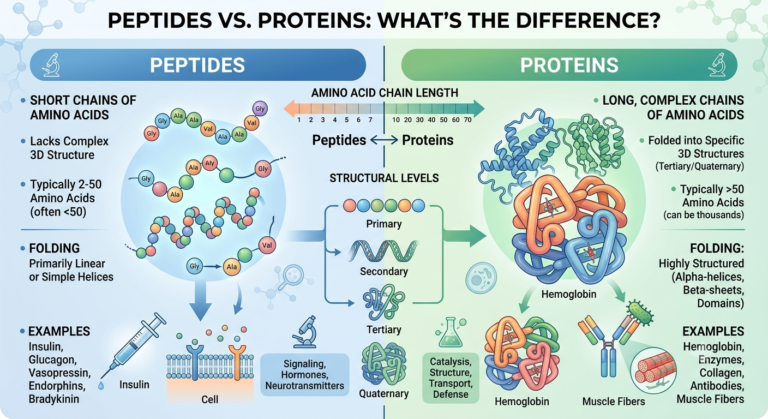
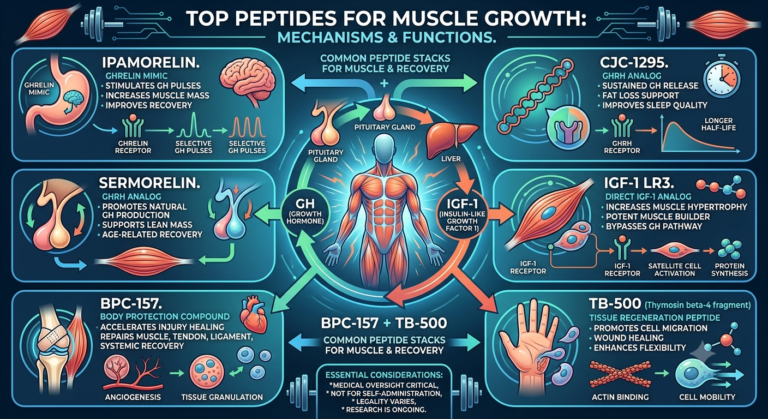
Before comparing these two peptides, it helps to understand what they are. Both CJC-1295 and Ipamorelin belong to a class of compounds called growth hormone secretagogues (GHSs) —substances that stimulate your pituitary gland to release more growth hormone (GH) .
Unlike direct GH injections, which flood your system with synthetic hormone, GHSs work by mimicking your body’s natural signaling molecules. They bind to specific receptors in the brain and trigger a pulsatile release of GH—the same pattern your body naturally follows . This is important because continuous GH elevation (like you would get from exogenous HGH) can cause desensitization over time. Pulsatile release, on the other hand, maintains your body’s natural feedback loops.
The two peptides work through different receptors:
- CJC-1295 targets the GHRH receptor (growth hormone-releasing hormone receptor)
- Ipamorelin targets the GHS-R1a receptor (the ghrelin receptor)
This receptor difference is why they produce different GH release patterns and why they are so effective when combined.
CJC-1295: The Sustained GH Elevator
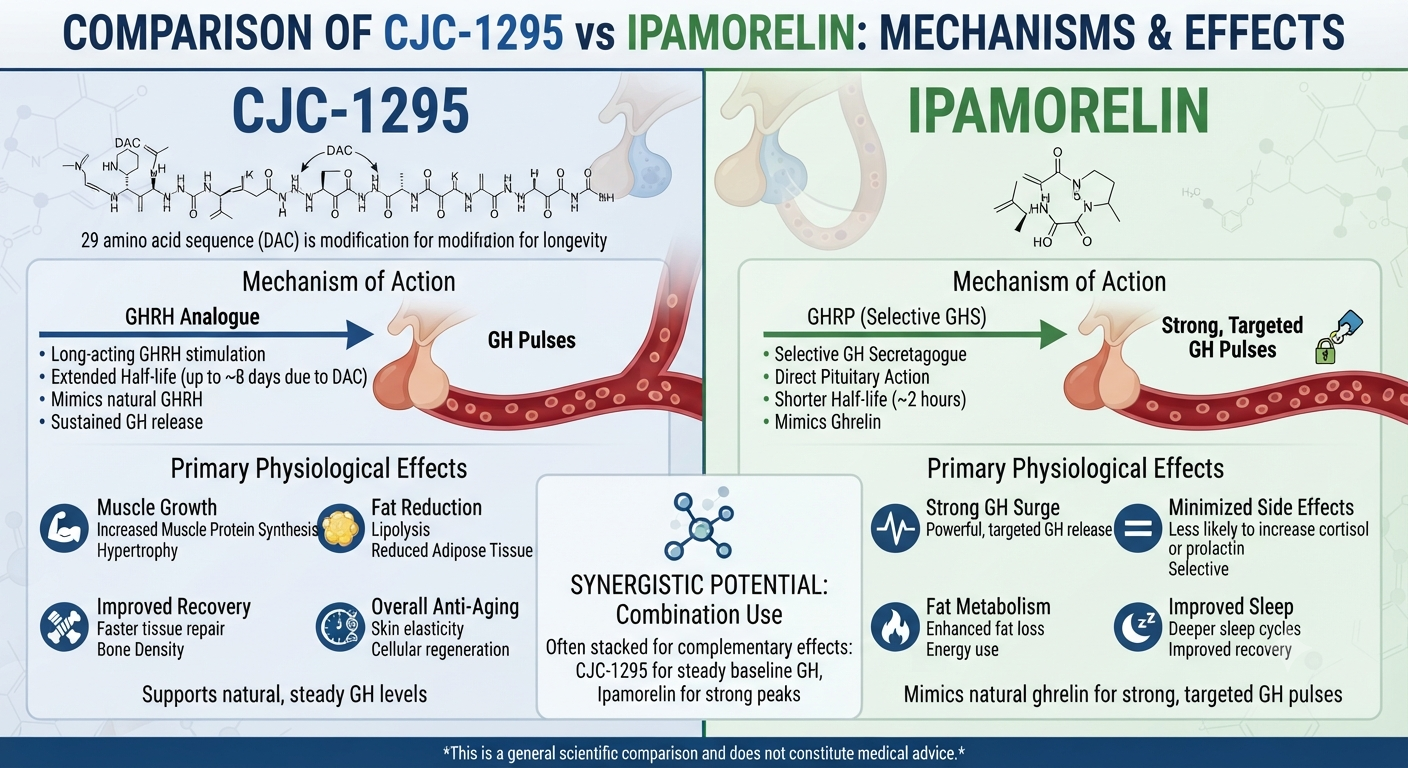
CJC-1295 is a synthetic analog of growth hormone-releasing hormone (GHRH)—the natural signal your hypothalamus sends to your pituitary to release GH . The key innovation is that it is engineered to last much longer than natural GHRH.
Natural GHRH has a half-life of minutes. CJC-1295 extends that significantly.
The DAC Difference
CJC-1295 exists in two primary forms, and the distinction matters:
CJC-1295 with DAC (Drug Affinity Complex):
The DAC modification attaches to serum albumin in your blood, creating a slow-release reservoir that keeps GH levels elevated for up to 8 days from a single injection . This means less frequent dosing—typically 1 to 2 mg once weekly .
CJC-1295 without DAC (also called Mod GRF 1-29):
Without the DAC, this form has a short half-life of about 30 minutes . It produces a quick, natural pulse of GH that aligns with your body’s own rhythm. Dosing is typically 100 mcg, 1 to 3 times daily .
The with-DAC form is more convenient (fewer injections). The without-DAC form provides more control over timing—ideal for dosing around sleep or workouts .
How CJC-1295 Works
CJC-1295 binds to GHRH receptors on pituitary somatotrophs and signals the release of GH. This sustained signaling elevates both GH and IGF-1 over an extended period .
A 2006 clinical trial showed that CJC-1295 increased IGF-1 levels by up to 2- to 3-fold over baseline for about a month after a single injection series . The FDA notes that CJC-1295 DAC levels could still be measured up to 72 hours post-injection .
Potential Benefits of CJC-1295
Research and clinical experience associate CJC-1295 with several potential benefits :
- Sustained GH and IGF-1 elevation – More consistent support over days
- Improved muscle protein synthesis – Supports lean muscle growth
- Enhanced fat burning – Helps reduce body fat
- Better sleep quality – Users commonly report deeper sleep
- Anti-aging support – May improve skin elasticity and recovery
Common Side Effects
Side effects are generally mild but worth noting :
- Mild injection-site reactions (redness, itching, swelling)
- Headache
- Water retention or mild bloating
- Transient dizziness or flushing
- Nausea or abdominal discomfort
FDA documents report that injection-site reactions were observed in almost all study participants who received CJC-1295 DAC . There is also theoretical concern about pituitary overstimulation with long-term use, as the potential for pituitary gland hyperplasia cannot be ruled out due to the lack of carcinogenicity studies .
Regulatory and Safety Considerations
CJC-1295 was first identified in 2005 by ConjuChem Biotechnology but was withdrawn from clinical trials later that year . FDA documents confirm that CJC-1295-related bulk drug substances are not approved for clinical use in the United States . Long-term safety data in humans are unknown, and there are no data to inform safety for use in the pediatric population .
Ipamorelin: The Selective GH Releaser
Ipamorelin is a pentapeptide derived from GHRP-1 . It is a growth hormone-releasing peptide (GHRP) that mimics ghrelin—your body’s natural “hunger hormone” that also signals GH release .
How Ipamorelin Works
Ipamorelin binds selectively to the GHS-R1a receptor on the pituitary gland . What makes it special is its selectivity. Unlike older GHRPs like GHRP-6, which also trigger appetite stimulation and cortisol release, Ipamorelin cleanly activates only the GH pathway .
This means you get a meaningful bump in growth hormone—enough to support muscle protein synthesis, fat metabolism, and recovery—without the hormonal chaos that comes with less refined compounds.
Ipamorelin’s GH Release Profile
A pharmacokinetic study of Ipamorelin in healthy volunteers provides a clear picture of its action :
- Peak GH release occurs at approximately 0.67 hours (about 40 minutes) after administration
- Half-life is approximately 2 hours
- Clearance is 0.078 L/h/kg
- Volume of distribution at steady-state is 0.22 L/kg
The time course of GH stimulation shows a single episode of GH release with a rapid decline to negligible GH concentration at all doses . This single-pulse profile is important because it closely mimics your body’s natural GH pulses.
Potential Benefits of Ipamorelin
Research and clinical experience associate Ipamorelin with several potential benefits :
- Fat loss while preserving lean muscle
- Improved recovery after exercise or injury
- Deeper, more restful sleep
- Steady energy and reduced fatigue
- Minimal impact on other hormones (no significant cortisol or prolactin spikes)
A rodent study of postoperative ileus found that repetitive intravenous ipamorelin administration significantly increased fecal pellet output, food intake, and body weight gain .
Common Side Effects
Ipamorelin is generally well tolerated, with side effects typically mild :
- Temporary flushing or warmth
- Slight increase in appetite (this is actually a benefit for some)
- Mild headache
- Injection-site reactions
Regulatory and Safety Considerations
A 2026 FDA review of Ipamorelin-related bulk drug substances for compounding raised several safety concerns :
- In a clinical study of patients with postoperative ileus who received IV ipamorelin, adverse events included hypokalemia, insomnia, hyperglycemia, nausea, vomiting, abdominal distention, and death (though it was unclear whether the two deaths were related to ipamorelin)
- Potential for glucose intolerance and diabetes mellitus similar to other GH-stimulating products
- Concern about immunogenicity due to the potential for aggregation and peptide-related impurities
- Possible behavioral reinforcing properties that could contribute to addiction
- Potential negative effects on reproductive health and pregnancy
Ipamorelin is not approved for clinical use in the United States.
CJC-1295 vs Ipamorelin: Side-by-Side Comparison
The Combination: Why They Work Better Together
The most common clinical approach is to use both peptides together. This is not because one is insufficient on its own, but because they work through different mechanisms that complement each other .
The synergistic effect works like this:
- CJC-1295 provides the sustained baseline—keeping GH and IGF-1 elevated over days
- Ipamorelin provides the acute pulses—giving you a spike of GH when it matters most (around workouts or during sleep)
By hitting both the GHRH and ghrelin receptors simultaneously, this stack can increase GH output by 2-3x compared to either peptide alone .
Typical combination protocol (with DAC):
Typical combination protocol (without DAC):
This combination creates a more natural GH rhythm—sustained support with acute pulses—supporting fat loss, muscle preservation, recovery, and overall anti-aging.
Choosing Between CJC-1295 and Ipamorelin
The right choice depends on your goals and lifestyle :
Choose CJC-1295 if:
- You want sustained GH and IGF-1 elevation for long-term support
- You prefer fewer injections (weekly dosing with DAC)
- Your primary goals are muscle growth and anti-aging
- You want a consistent baseline GH elevation
Choose Ipamorelin if:
- Your focus is fat loss, recovery, or sleep
- You want quick pulses of GH around workouts
- You prefer a more selective option with minimal side effects
- You want to avoid appetite stimulation (though mild, it is present)
Choose both if:
- You are looking for comprehensive support for fat loss, muscle, recovery, and performance
- You want both sustained GH elevation and acute pulses
- You are willing to commit to the dosing schedule
Safety and Monitoring
Both peptides have favorable safety profiles in short-term studies, but they are not without risks .
Important Considerations
Both peptides:
- Are not FDA-approved for human use in the United States
- Should only be used under medical supervision
- Require baseline and ongoing lab monitoring (GH, IGF-1, glucose, thyroid)
- Carry theoretical risks of pituitary overstimulation with long-term use
CJC-1295 specific:
- Injection-site reactions are common
- Long-term safety data are unknown
- There is a lack of carcinogenicity studies
Ipamorelin specific:
- May affect glucose tolerance and increase diabetes risk
- Potential for immunogenicity with injectable forms
- May have behavioral reinforcing properties
- May negatively affect reproductive health and pregnancy
Never self-prescribe peptide therapy. Always work with a qualified healthcare provider who can:
- Assess your baseline health and hormone levels
- Determine whether peptide therapy is appropriate for you
- Design a customized dosing protocol
- Monitor your response and adjust as needed
- Source peptides from accredited compounding pharmacies
Bottom Line
CJC-1295 and Ipamorelin are both effective growth hormone secretagogues, but they serve different primary functions :
- CJC-1295 offers sustained GH and IGF-1 elevation. It is the better option for long-term muscle growth, anti-aging, and consistent GH support. The with-DAC form is convenient (weekly dosing). The without-DAC form offers more control over timing.
- Ipamorelin provides acute, pulsatile GH release. It is the better option for fat loss, recovery, and sleep. Its selectivity means minimal side effects like cortisol or prolactin spikes.
- Consider combining them if you want comprehensive support for both sustained GH elevation and acute pulses—often described as addressing two sides of the recovery equation.
As of 2026, neither CJC-1295 nor Ipamorelin is FDA-approved for human use . Both are classified as research peptides. Anyone considering these compounds should only do so under qualified medical supervision with proper monitoring protocols.
Disclaimer: This article is for informational purposes only and does not constitute medical advice. Peptides are research chemicals and are not approved for human consumption in many jurisdictions. Always consult a qualified healthcare professional before starting any peptide therapy.
Read also