CagriSema vs Retatrutide: Which Wins on Weight Loss in 2026?
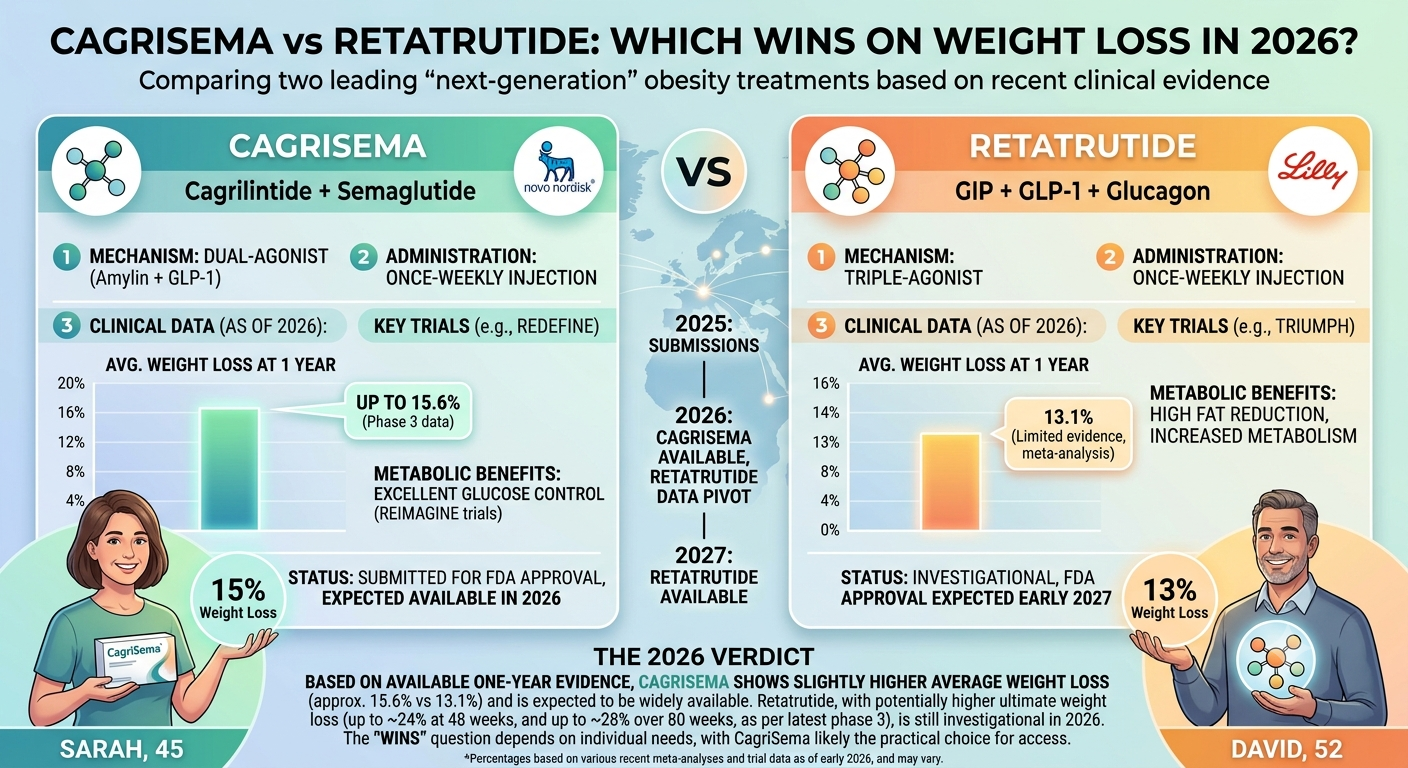
CagriSema vs Retatrutide :The race for the most effective weight loss medication has intensified, with two contenders dominating the conversation: CagriSema and Retatrutide. On paper, Retatrutide appears to lead with reported weight loss of 28.3% at 12 mg over 80 weeks in the phase 3 TRIUMPH-1 trial, compared to CagriSema’s 22.7% over 68 weeks in REDEFINE 1. However, these figures come from different trials, durations, estimands, and evidence tiers—so subtracting one from the other is statistically meaningless.
This article examines what each drug has proven, how to read the datasets side by side, and what actually matters for anyone trying to make sense of these two promising treatments.
Quick Takeaways
The Headline Numbers: What the Data Actually Says
Every phase 3 weight-loss result from either drug, with its conditions:
Why the Numbers Are Not Directly Comparable
The two datasets are from separate trials with different designs. Subtracting one figure from the other is arithmetic, not evidence. Claims of the form “Retatrutide beats CagriSema by X percentage points” have no confidence interval because no trial estimated that difference.
Duration
REDEFINE 1 stopped at 68 weeks; TRIUMPH-1 ran to 80 weeks. Twelve extra weeks on a still-descending weight-loss curve is not free. In a prespecified extension of TRIUMPH-1, participants who continued retatrutide 12 mg to 104 weeks reached 30.3% weight loss .
Estimand Differences
CagriSema is quoted at both 22.7% and 20.4%—these are not two studies but one study analyzed two ways. The trial product estimand assumes full adherence: 22.7% against 2.3% placebo. The treatment policy estimand counts everyone randomized, whether they stayed on drug or not: 20.4% against 3.0% .
Lilly uses the same two lenses under different labels. The rule: match the lens. Trial product against efficacy is 22.7% versus 28.3%; treatment policy against treatment regimen is 20.4% versus 25.0%. Quoting retatrutide’s 28.3% against CagriSema’s 20.4% inflates the gap by roughly three points.
Population Differences
REDEFINE 1 excluded any diabetes history and required BMI 30+ (or 27+ with complications) . TRIUMPH-3 enrolled BMI 35+ with cardiovascular disease; TRIUMPH-4 enrolled knee osteoarthritis patients . Different populations respond differently to treatment.
Evidence Tier
CagriSema’s numbers are peer-reviewed in the New England Journal of Medicine . Every retatrutide phase 3 figure comes from an Eli Lilly press release . Company toplines are usually accurate on direction, but they are selected summaries. Retatrutide’s peer-reviewed record is still the 2023 phase 2 trial.
Mechanism: How Each Drug Works
CagriSema: Two Molecules, Two Pathways
CagriSema is a fixed-dose co-formulation of:
- Cagrilintide: A long-acting acylated amylin analogue acting as a non-selective agonist at amylin and calcitonin receptors
- Semaglutide: A GLP-1 receptor agonist
Natural amylin is a pancreatic hormone that produces satiety. The combination approach led to 60% of participants reaching ≥20% weight loss, and 23% reaching ≥30% in REDEFINE 1 . The amylin component is worth about 6.6 percentage points: CagriSema 22.7%, semaglutide alone 16.1%, cagrilintide alone 11.8% .
Retatrutide: One Molecule, Three Receptors
Retatrutide is a single molecule that activates three receptors:
- GIP receptor: Enhances fat metabolism and insulin sensitivity
- GLP-1 receptor: Suppresses appetite and regulates blood sugar
- Glucagon receptor: May reduce liver fat by stimulating hepatic fatty acid oxidation and raising energy expenditure
In preclinical models, retatrutide raised energy expenditure beyond calorie-intake-matched controls. The TRIUMPH program includes four phase 3 trials evaluating retatrutide across obesity, obstructive sleep apnea, knee osteoarthritis, and cardiovascular disease .
Tolerability: The Closest Thing to a Fair Comparison
Gastrointestinal Events
REDEFINE 1 (CagriSema): 79.6% of the treatment group experienced GI events versus 39.9% on placebo, mostly transient and mild-to-moderate. Discontinuation for adverse events was 6.0% versus 3.7% .
TRIUMPH-1 (Retatrutide 12 mg): Nausea 42.4%, diarrhea 32.0%, constipation 26.1%, vomiting 25.3% (placebo 14.8%, 13.5%, 10.9%, 4.8%). Discontinuation for adverse events was dose-dependent: 11.3% at 12 mg, 6.9% at 9 mg, 4.1% at 4 mg, against 4.9% placebo .
The Dysesthesia Signal
Dysesthesia—an abnormal or unpleasant skin sensation—has no counterpart in the CagriSema data. TRIUMPH-4 reported it in 20.9% of the 12 mg group against 0.7% placebo. These events were generally mild and rarely led to treatment discontinuation . It is a new signal for the class, scales with dose, and explains much of the discontinuation gap.
Duration-Matched Comparison
At 68 weeks, TRIUMPH-4’s 28.7% at 12 mg came with an 18.2% discontinuation rate against 4.0% placebo—roughly three times CagriSema’s 6.0% . The populations differ, so this is the closest read available rather than a clean one.
The Tirzepatide Bridge: What It Tells Us
With no direct head-to-head trial of retatrutide vs CagriSema, the defensible way to connect the programmes is through a shared comparator: tirzepatide.
CagriSema vs Tirzepatide: REDEFINE 4
CagriSema has already made that run—and lost. REDEFINE 4 was an open-label head-to-head in 809 adults with obesity over 84 weeks. CagriSema produced 23.0% against tirzepatide 15 mg at 25.5% (efficacy estimand), and 20.2% against 23.6% (treatment regimen). The primary endpoint of non-inferiority was not met .
Retatrutide vs Tirzepatide: TRIUMPH-5
Retatrutide’s equivalent is TRIUMPH-5 (NCT06662383), a double-blind phase 3 trial against tirzepatide in 800 adults with obesity, running about 89 weeks, with primary completion listed for November 2026 and study completion for December 2026 . That readout, not cross-trial arithmetic, settles the question.
Regulatory Status: One Is Filed, One Is Not
| Drug | Filing Status | Expected Decision |
|---|---|---|
| CagriSema | NDA filed December 18, 2025 | Late 2026 |
| Retatrutide | BLA planned Q1 2027 | 2027 |
Neither is approved anywhere as of August 2026. CagriSema is roughly a year ahead in the regulatory process. Novo Nordisk has also planned a higher-dose CagriSema 2.4/7.2 mg phase 3 trial for the second half of 2026, and REDEFINE 11 data expected in the first half of 2027 .
The Bottom Line
On the raw numbers, retatrutide is ahead: 28.3% mean weight loss at 12 mg over 80 weeks against 22.7% for CagriSema over 68 weeks. But those figures come from different trials, durations, estimands, and evidence tiers.
For the largest demonstrated phase 3 weight loss, retatrutide: 28.3% at 12 mg over 80 weeks, with 62.5% reaching 25% or more, 45.3% reaching 30% or more, and 27.2% reaching 35% or more . In a 104-week extension, participants reached 30.3% weight loss .
For results delivered with fewer dropouts, CagriSema: 6.0% discontinuation over 68 weeks against 18.2% for retatrutide in TRIUMPH-4 .
For whichever you might be prescribed first, it’s CagriSema—by about a year .
The answer that actually settles the question is TRIUMPH-5 reading out in December 2026, which paired with REDEFINE 4 gives both drugs a measured result against the same comparator. A systematic review and network meta-analysis published in The BMJ ranked tirzepatide (−14.9%) and CagriSema (−14.8%) as the most effective for one-year weight loss versus lifestyle modification, while emerging agents including retatrutide suggested similar magnitudes at low to very low certainty . The uncomfortable message is that benefit and harm scale together: the highest rates of discontinuation due to adverse events cluster among the most potent drugs .
Frequently Asked Questions
Is retatrutide better than CagriSema for weight loss?
On reported phase 3 numbers, yes: 28.3% at 12 mg over 80 weeks against 22.7% over 68 weeks, matching estimands . No trial has compared them directly, so that gap is a cross-trial observation, not a measured difference.
Has there ever been a head-to-head trial of retatrutide vs CagriSema?
No. A ClinicalTrials.gov query for both compounds returns an empty result set. The nearest bridge is tirzepatide as a shared comparator .
Why does CagriSema have two different weight-loss figures?
Same trial, two analyses. The trial product estimand assumes full adherence and gives 22.7%; treatment policy counts everyone randomized and gives 20.4% .
Is retatrutide’s 24.2% figure still current?
No. 24.2% was the 12 mg result at 48 weeks in the phase 2 trial. TRIUMPH-1 has since reported 28.3% at 80 weeks .
Which one is better tolerated?
CagriSema, on available evidence. Discontinuation for adverse events was 6.0% in REDEFINE 1 versus 18.2% at 12 mg in TRIUMPH-4. Retatrutide also carries a dysesthesia signal with no CagriSema counterpart .
Which will be available first?
CagriSema. Its FDA filing went in on December 18, 2025, with a decision expected in late 2026; Lilly plans a retatrutide BLA in Q1 2027 .
Read also
Collagen Peptides: The One ‘Peptide Supplement’ With Real Evidence Behind It