Copper Peptides vs. PP405: Best Hair Regrowth Options
Copper Peptides vs. PP405 :Hair loss affects millions worldwide, and for many, traditional treatments like minoxidil and finasteride come with limitations—slow results, side effects, or dependence on continued use. Two newer approaches have generated significant interest: copper peptides (GHK-Cu) and PP405. Both show promise, but they work through entirely different mechanisms.
This guide compares these two options side-by-side, covering how each works, what clinical evidence exists, delivery methods, and who might benefit most from each approach.
Quick Comparison
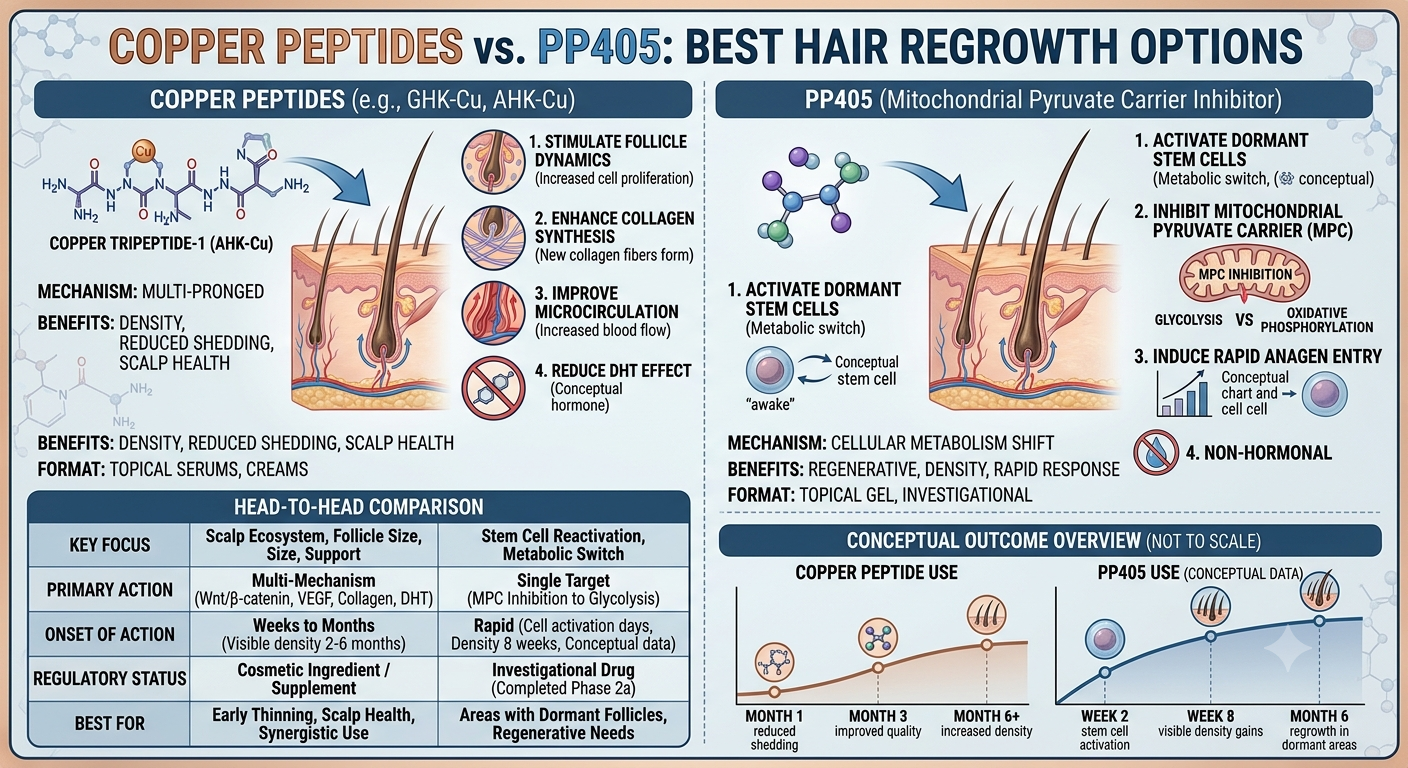
| Feature | Copper Peptides (GHK-Cu) | PP405 |
|---|---|---|
| Primary Mechanism | Gene modulation, tissue repair, improved blood flow, collagen production | Reactivates dormant hair follicle stem cells via metabolic pathway control |
| Application | Topical serums or injections | Topical gel |
| Time to Visible Results | 3–4 months for initial changes; significant results in 4–6 months | Visible results in as little as 4–8 weeks |
| Clinical Data | Well-established; decades of research; 27% density increase in some studies | Phase 2a data: 31% of participants had >20% density increase by week 8 |
| Systemic Absorption | Minimal | None detected |
| Side Effects | Mild redness, irritation; rare contact dermatitis | Well-tolerated; no serious adverse events reported |
| Availability | Widely available over-the-counter | Experimental; Phase 3 trials planned for 2026; potential market release 2027–2028 |
| Best For | Early-stage thinning, sensitive scalp, holistic approach, scalp health maintenance | Dormant follicles, more advanced loss, rapid response |
What Are Copper Peptides (GHK-Cu)?
Copper peptides, specifically GHK-Cu, are naturally occurring peptide complexes found in human blood plasma, saliva, and tissues. They consist of three amino acids bound to a copper ion .
GHK-Cu levels decline significantly with age—from about 200 ng/mL at age 20 to roughly 80 ng/mL by age 60—which correlates with reduced tissue repair capacity and increased vulnerability to hair thinning .
Mechanism of Action
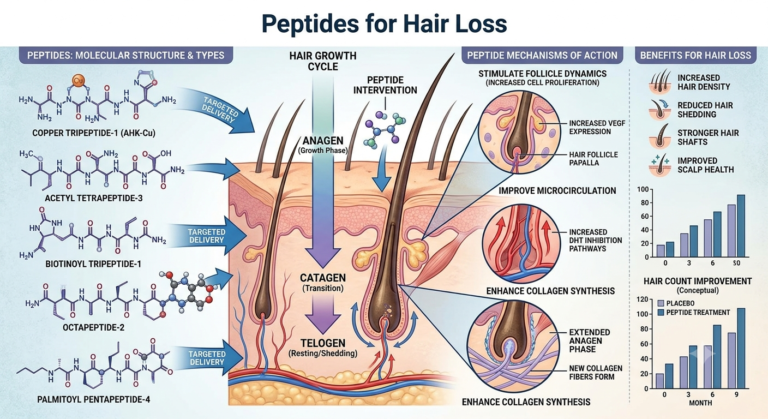
Copper peptides work through multiple pathways that support scalp health and hair growth :
Prolonging the Anagen Phase: GHK-Cu helps extend the active growth phase of the hair cycle, keeping hair anchored to the scalp longer before shedding.
Stimulating Angiogenesis: Copper peptides promote the formation of new blood vessels, improving blood flow and nutrient delivery to hair follicles.
Supporting Follicle Size: By stimulating collagen and elastin production, GHK-Cu may help reverse follicle miniaturization and support thicker hair strands.
Anti-inflammatory Effects: GHK-Cu has anti-inflammatory properties that can help calm scalp inflammation, creating a healthier environment for hair growth.
Gene Modulation: Copper peptides influence thousands of genes involved in tissue repair and regeneration, including VEGF and HGF signaling that support follicular health .
Clinical Evidence
Several studies support GHK-Cu’s effectiveness for hair growth:
- Female volunteers using GHK-Cu in nano-lipid carriers twice daily reported a 27% increase in hair density after six months .
- A clinical study combining copper peptides with minoxidil-dutasteride delivered via scalp tattooing reported median top-scalp regrowth of 26.5% after five monthly sessions in men with androgenetic alopecia .
- In cell research, GHK-Cu increased dermal papilla cell proliferation by up to 70% compared to untreated controls .
Delivery Methods
Topical Serums: The most common and accessible method. Clinical standards suggest 1.5% to 3% concentration for visible results. Applied daily, they penetrate the skin barrier to reach follicles .
Injections: More effective than topical application because they bypass the skin barrier and deliver peptides directly to deeper layers. However, they are more expensive, require medical professional administration, and are less convenient .
Timeline for Results
Patience is essential with copper peptides. The hair growth cycle is long, and GHK-Cu works by stimulating follicles rather than forcing rapid growth. Visible results, such as reduced shedding and increased vellus hair, may appear within 2–3 months, but significant improvements in density and thickness often take 4–6 months of consistent daily application .
What Is PP405?
PP405 is an experimental topical compound developed by Pelage Pharmaceuticals, a startup founded by UCLA researchers. Unlike copper peptides, PP405 targets a metabolic switch that controls hair follicle stem cell dormancy versus activation .
Mechanism of Action
The science behind PP405 is innovative :
Stem Cell Reactivation: UCLA researchers discovered that active hair follicle stem cells generate higher lactate levels than dormant cells. PP405 inhibits the mitochondrial pyruvate carrier (MPC), shifting cellular metabolism toward lactate production and reactivating dormant follicle stem cells.
Glycolytic Metabolism: PP405 stimulates glycolytic metabolism within stem cells. This process increases lactate production, which acts as a metabolic trigger that pushes follicles from a resting phase into an active growth phase.
Topical, Targeted Approach: PP405 is designed as a topical gel that is unstable in the bloodstream, meaning it acts locally on the scalp with minimal to no systemic absorption .
Phase 2 Clinical Results
Phase 2a trial results have generated significant interest :
- 78 adults with androgenetic alopecia used 0.05% PP405 gel or placebo daily for four weeks
- By week eight, 31% of participants had more than a 20% increase in hair density — essentially reversing a significant portion of their hair loss
- No participants in the placebo group saw comparable results
- Treated follicles showed increased Ki67 activity (a marker of cellular proliferation)
- No serious adverse events were reported, and no systemic absorption was detected
Dr. Qing Yu Christina Weng, a dermatologist and chief medical officer involved in the trials, stated: “We were blown away [by the results]. After just four weeks, you wouldn’t expect any separation between the treatment group and the placebo group. And not only were they growing new hair where there wasn’t any before, it wasn’t peach fuzz or baby hair—it was proper, thick hair” .
Timeline and Availability
- Phase 3 trials are expected in 2026
- Potential market availability is projected for 2027–2028
- Some early users in trials experienced visible growth within as little as one week of daily application, though this was not the typical response
Head-to-Head Comparison
How They Compare vs. Minoxidil
Copper peptides and PP405 both represent alternatives to traditional treatments like minoxidil and finasteride.
Copper Peptides vs. Minoxidil :
| Feature | Copper Peptides | Minoxidil |
|---|---|---|
| Mechanism | Peptide signaling, tissue repair, inflammation reduction | Vasodilation, K+ channel opening |
| Shedding Phase | Generally none | Often severe initial shedding |
| Scalp Irritation | Low (but possible) | High (itching, flaking, redness) |
| Long-term Dependency | No severe withdrawal | Hair falls out if discontinued |
| Best For | Early-stage thinning, sensitive scalp | Advanced genetic hair loss |
PP405 vs. Minoxidil and Finasteride :
PP405 offers several advantages over traditional options:
- Faster results (visible at 4–8 weeks vs. 4–6 months)
- Minimal systemic absorption reduces side effect risk
- Targets dormant follicles, potentially regrowing hair in areas where existing treatments might only maintain
- No sexual side effects associated with finasteride
Which Is More Effective for Hair Density?
The data suggests different strengths:
| Metric | Copper Peptides | PP405 |
|---|---|---|
| Density increase | Up to 27% over 6 months | 31% of patients had >20% density increase at 8 weeks |
| Patient population | Mixed (includes women) | Androgenetic alopecia (men and women) |
| Duration to results | 3–4 months initial, 4–6 months significant | 4–8 weeks visible |
| Evidence strength | Multiple studies, decades of data | Phase 2a data, Phase 3 pending |
Safety and Tolerability
- Generally considered safe for topical use
- Mild redness, irritation, dryness, or peeling possible with overuse
- Individuals with Wilson’s disease or other copper-handling disorders should avoid
- No systemic side effects reported with topical use
- Good tolerability in Phase 1 and 2a trials
- No serious adverse events detected
- No measurable systemic absorption in blood testing
- Long-term safety data still pending
Which One Should You Choose?
Choose Copper Peptides If:
- You’re experiencing early-stage thinning or want to maintain scalp health
- You have a sensitive scalp or have reacted poorly to minoxidil
- You prefer a natural, well-established approach with decades of research
- You want a holistic, scalp-focused treatment that also improves skin health
- You’re willing to wait 3–6 months for significant results
- You want something available now without waiting for regulatory approval
Choose PP405 If:
- You want potentially faster results (4–8 weeks)
- You have dormant follicles that may respond to stem cell reactivation
- You’re dealing with more advanced hair loss where other treatments have failed
- You want a novel mechanism that doesn’t involve hormones or vasodilation
- You’re willing to wait for FDA approval (2027–2028) or participate in clinical trials
- You prefer a topical treatment with zero systemic absorption
Can You Use Both?
Potentially yes. Copper peptides and PP405 work through completely different biological pathways. Copper peptides support scalp health, blood flow, and follicle nutrition, while PP405 reactivates dormant stem cells metabolically.
Some experts suggest combining multiple treatment modalities to address hair loss from different angles. As with any regimen, consult a healthcare provider before combining treatments .
Frequently Asked Questions
Are copper peptides effective for hair loss?
Yes, copper peptides (GHK-Cu) have shown effectiveness in multiple clinical settings. Studies report up to 27% density increases and reduced shedding with consistent use. However, they are most effective for early-stage thinning and may not work for everyone .
Is PP405 better than minoxidil?
Early data suggests PP405 may produce faster results (4–8 weeks vs. 4–6 months) and has a favorable safety profile with no systemic absorption. However, PP405 is still experimental, while minoxidil has decades of established clinical evidence .
When will PP405 be available?
Phase 3 trials are planned for 2026. If trials are successful, potential market availability is projected for 2027–2028 .
Do copper peptides cause shedding?
Generally, no. Unlike minoxidil, copper peptides gently support the anagen (growth) phase without forcibly disrupting the hair cycle .
Can I use copper peptides and PP405 together?
In theory, yes—they work through different pathways. However, since PP405 is still experimental, there is no clinical data on combining them. Always consult a healthcare provider before starting any new treatment .
The Bottom Line
Copper peptides and PP405 represent two different approaches to hair regrowth. Copper peptides are a well-established, accessible option that supports scalp health through gene modulation, improved blood flow, and inflammation reduction. PP405 is an emerging breakthrough that reactivates dormant hair follicles through metabolic pathway control, with impressive early-phase data.
For those seeking a proven, available treatment, copper peptides offer a safe, effective option—particularly for early-stage thinning and scalp maintenance. For those with more advanced hair loss who are willing to wait for regulatory approval, PP405 represents one of the most promising developments in hair loss research in recent years.
Ultimately, the “best” option depends on your individual hair loss pattern, timeline, budget, and risk tolerance. Both approaches represent meaningful progress in treating a condition that affects millions worldwide.
Read also