Peptides for Nail Health & Growth: What Works and Why
Brittle, slow-growing nails that peel, crack, and break easily are more than a cosmetic inconvenience. For millions of people, they are a persistent frustration that resists every topical treatment on the shelf. The core problem is that most nail products address the symptom — the visible nail plate — while ignoring the biology that produces it.
Peptides have emerged as a genuinely science-backed approach to nail health because they work at the level where nails are actually made: the matrix. This guide examines what the research shows, which peptides have real evidence behind them, and how to tell the difference between a clinically studied ingredient and a marketing claim.
At a Glance
| Category | Key Point |
|---|---|
| What nails are made of | Primarily keratin, but structurally dependent on collagen in the nail bed and matrix |
| Strongest evidence | Oral collagen peptides — specifically VERISOL® at 2.5 g/day |
| Documented results | 12% increase in nail growth rate; 42% reduction in broken nails |
| Second category | Topical antimicrobial peptides for fungal-related nail damage |
| Third category | Copper peptides (GHK-Cu) for tissue repair and keratin integrity |
| Realistic timeline | 8–12 weeks for measurable change; 6 months for full nail replacement |
| Critical caveat | Nails grow slowly — no peptide produces fast results, and any product claiming to is misrepresenting the biology |
The Problem: Brittle Nail Syndrome
Brittle nail syndrome is a common condition characterized by nails that are weak, thin, rough, and prone to peeling or splitting. It affects a substantial portion of the population — women more often than men — and has multiple possible causes.
Common Causes
| Cause | Mechanism |
|---|---|
| Aging | Reduced collagen production and slower cell turnover in the nail matrix |
| Repeated water exposure | Repeated wetting and drying cycles cause the nail plate to expand and contract, weakening the keratin structure |
| Chemical exposure | Detergents, acetone, and cleaning agents strip lipids from the nail plate |
| Nutritional deficiencies | Iron, zinc, biotin, and protein deficiencies impair keratin synthesis |
| Underlying health conditions | Hypothyroidism, anemia, and psoriasis affect nail formation |
| Fungal infection | Onychomycosis degrades the nail plate from within |
| Mechanical trauma | Aggressive filing, picking, and improper manicure technique |
Why Topical Treatments Often Fail
Topical moisturizers, strengtheners, and hardeners address the surface of the nail plate. They can temporarily improve appearance and reduce further damage, but they cannot correct a structural weakness that originates in the matrix — the tissue at the base of the nail where new cells are produced and where the nail’s architecture is determined.
If the matrix is not receiving adequate structural building blocks, the nail it produces will be weak regardless of what is applied to it afterward.
How Peptides Support Nail Health
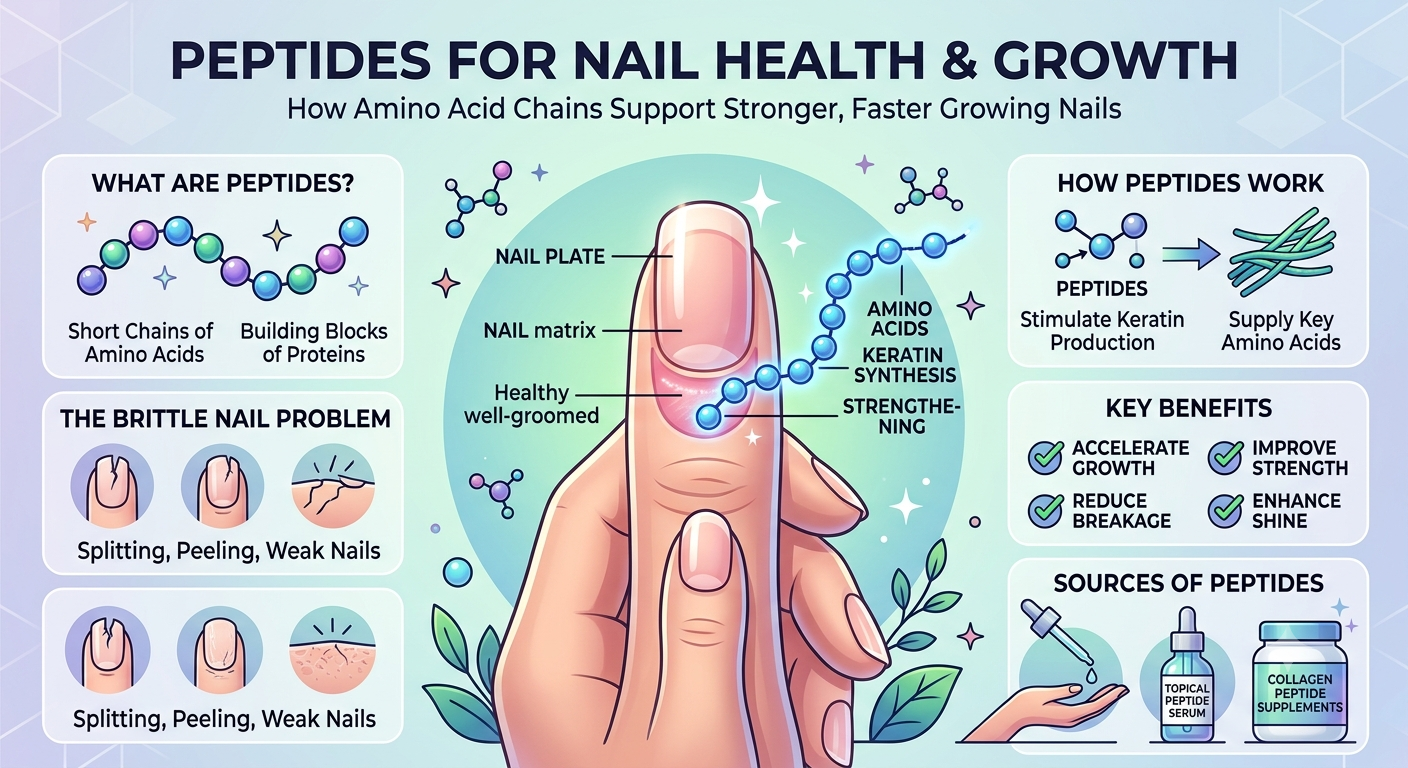
To understand why peptides matter for nails, it helps to understand what nails are actually made of and what they depend on.
The Structure of a Nail
| Component | Function |
|---|---|
| Nail plate | The visible hard surface — composed primarily of keratin |
| Nail matrix | The tissue at the base that produces new nail cells |
| Nail bed | The skin beneath the nail plate that supports it |
| Cuticle | The seal that protects the matrix from infection |
| Lunula | The visible part of the matrix at the base of the nail |
Nails are primarily composed of keratin, a tough fibrous protein that provides hardness and structure. But keratin does not exist in isolation. The nail bed and matrix depend on a supporting network of proteins — most importantly collagen — that provides the foundation for healthy nail growth.
The Key Insight
Nails need structural support beyond keratin. Collagen is a major structural protein in the nail bed and matrix, and without adequate collagen, nails can become weak, thin, and brittle.
This is where collagen peptides — short, absorbable chains of amino acids derived from collagen — offer a specific advantage over whole collagen, which is too large to be efficiently absorbed.
The Science of Collagen Peptides for Nails
How Collagen Peptides Reach the Nail Matrix
When you consume collagen peptides, they are broken down further during digestion into small peptide fragments. Some of these fragments — particularly those containing hydroxyproline — survive the digestive process and enter the bloodstream intact rather than being fully degraded into individual amino acids.
Once in circulation, these peptides can reach peripheral tissues, including the nail matrix, where they appear to act as signaling molecules rather than simply as amino acid building blocks. Research suggests they stimulate fibroblasts and other cells involved in connective tissue production.
What the Clinical Research Shows
The evidence for collagen peptides and nail health is strongest for specific, well-characterized formulations rather than for collagen in general.
| Outcome | Documented Result |
|---|---|
| Nail growth rate | 12% increase with daily supplementation |
| Frequency of broken nails | 42% decrease |
| Surface roughness, peeling, chipping | Significant reduction |
| Self-reported appearance improvement | 80% of participants agreed |
| Self-reported strength improvement | 75% of participants agreed |
| Overall improvement rating | Nearly half rated 9–10 on a 10-point scale |
| Sustained effect after stopping | 88% continued to see improvement 4 weeks after discontinuation |
The Dosage and Duration Matter
These results were not achieved with arbitrary doses or short courses. The studied protocol was:
- 2.5 grams of specific bioactive collagen peptides per day
- 24 weeks (6 months) of consistent supplementation
This is important context. A collagen product that delivers 500 mg per serving, or a user who takes it for three weeks and stops, is not replicating the conditions under which the clinical results were observed.
Which Peptides Are Most Effective?
Not all peptides are interchangeable. The evidence base is concentrated in three specific categories, each with a different mechanism and a different best use case.
1. Collagen Peptides (Strongest Evidence for General Nail Health)
The strongest evidence for nail health comes from specific collagen peptide formulations. The most extensively studied is VERISOL®, a patented bioactive collagen peptide developed by GELITA.
What distinguishes VERISOL®: It is a specific, standardized collagen peptide fraction with a defined molecular weight distribution and amino acid profile, including hydroxyproline-containing sequences. This specificity is why the clinical results can be attributed to the ingredient rather than to collagen in general.
The studied protocol:
| Parameter | Detail |
|---|---|
| Dosage | 2.5 g per day |
| Duration | 24 weeks |
| Nail growth rate | +12% |
| Broken nail frequency | −42% |
| Participant satisfaction with appearance | 80% |
| Participant-reported stronger nails | 75% |
Why hydroxyproline matters: Peptides containing hydroxyproline resist degradation during digestion more effectively than other peptide sequences. This allows a greater proportion of the ingested peptide to reach target tissues intact, which is likely why this specific fraction produces measurable results where generic collagen does not.
2. Copper Peptides (GHK-Cu) — Emerging Evidence
GHK-Cu (glycyl-L-histidyl-L-lysine-copper) is a copper-binding tripeptide naturally present in human plasma. It has been studied extensively for tissue repair and regeneration, though its evidence base for nail health specifically is less developed than that of collagen peptides.
Documented biological activities:
- Stimulates collagen and elastin production
- Supports wound healing and tissue repair
- Supports keratin integrity and nail strength
- Reduces inflammation and oxidative stress
- Upregulates genes associated with tissue repair while downregulating genes linked to inflammation and degeneration
Where it fits: GHK-Cu is most often used topically in nail and skin formulations. Its mechanism — supporting the connective tissue environment around the nail matrix — is complementary to oral collagen peptides rather than a replacement for them.
Evidence caveat: Much of the GHK-Cu research is in vitro or in skin, not in nail-specific clinical trials. The nail-strength claims are plausible based on mechanism but are not supported by the same quality of nail-specific clinical data as the collagen peptide evidence.
3. Antimicrobial Peptides (Strong Evidence for Fungal Nail Damage)
A different category of peptides — antimicrobial peptides — has shown remarkable results for treating onychomycosis (nail fungus), which is one of the most common causes of brittle, discolored, thickened nails.
The standout study: A 2024 study published in the American Journal of Translational Research investigated the antifungal peptide hLF1-11, a synthetic fragment of human lactoferrin, applied topically.
Results:
| Outcome | Improvement Rate |
|---|---|
| Nail thickness reduction | 85% |
| Healthier skin around nails | 72% |
| Sensitivity/pain relief | 29% |
| Positive therapeutic effect overall | 88.9% of patients |
Spectrum of activity: The peptide was effective against a broad range of fungal species, including Trichophyton rubrum, Candida parapsilosis, and Aspergillus species.
Safety: No adverse effects were reported in the study.
Why this matters: Onychomycosis is notoriously difficult to treat. Oral antifungals carry liver monitoring requirements and drug interactions. Topical antifungals often penetrate poorly. A peptide that achieves 88.9% positive therapeutic effect with no reported adverse effects is a genuinely notable result — though larger and longer-term trials are still needed.
Oral vs. Topical: Choosing the Right Approach
Both routes have legitimate roles. The right choice depends on what is actually wrong with the nails.
| Approach | Best For | Evidence Strength | Realistic Timeline |
|---|---|---|---|
| Oral collagen peptides | Systemic support, addressing structural weakness, improving overall nail quality | Strong — multiple clinical trials with VERISOL® | 2–4 weeks for initial effects; 6+ months for full benefit |
| Topical copper peptides | Localized support, anti-aging, collagen stimulation around the matrix | Emerging — plausible mechanism, limited nail-specific trials | Typically 4–8 weeks |
| Topical antimicrobial peptides | Treating fungal infection (onychomycosis) | Strong — 88.9% positive effect in published study | 3–7 months for full resolution as the nail grows out |
A Practical Decision Framework
If your nails are brittle and slow-growing but not infected: Oral collagen peptides have the strongest clinical evidence. Look for a product that specifies the peptide type and provides dosing information.
If your nails are thickened, discolored, or crumbling: This suggests fungal involvement. Topical antimicrobial peptides have strong clinical support for this specific problem, and a fungal cause should be confirmed by a clinician before self-treating.
If you want comprehensive support: Oral collagen and topical peptides target different aspects of the problem and can be used together. Oral peptides provide systemic structural support; topical peptides address local tissue and any surface infection.
Practical Guidance: How to Actually Use Peptides for Nails
1. Choose a Clinically Studied Collagen Peptide — Not Just “Collagen”
The clinical results belong to specific, standardized formulations. Look for:
- A named, branded peptide ingredient (e.g., VERISOL®)
- A stated dose per serving that matches the research (2.5 g)
- A clear indication that the product is intended for oral use
A product that lists “collagen” without specifying the type, molecular weight, or dose is not a product you can evaluate against the evidence.
2. Be Consistent and Patient
Nails grow slowly. A fingernail takes approximately 3–6 months to grow from matrix to tip. This means:
- Initial effects: 2–4 weeks (subjective changes in texture and strength)
- Measurable change in growth rate: 8–12 weeks
- Full visible replacement of the nail: 3–6 months
Anyone expecting visible change in two weeks has misunderstood the biology. Anyone selling a product that promises it has misrepresented it.
3. Address the Root Cause
Brittle nails have multiple possible causes, and peptides only address some of them.
| If the cause is | Peptides may help by | Additional steps |
|---|---|---|
| Aging-related collagen loss | Supporting collagen in the matrix | General nutrition, sun protection for hands |
| Nutritional deficiency | Providing peptide building blocks | Correcting the specific deficiency (iron, zinc, biotin, protein) |
| Fungal infection | Antimicrobial peptides targeting the fungus | Confirming diagnosis; treating any underlying conditions |
| Chemical or water damage | Supporting recovery of the nail plate | Gloves, reduced water exposure, gentler products |
| Underlying health condition | Supporting general nail health | Treating the underlying condition with a clinician |
If your nails are brittle because of hypothyroidism, no peptide will correct that. If they are brittle because of a fungal infection, collagen peptides alone will not resolve it.
4. Don’t Neglect the Basics
Peptides work best alongside standard nail care, not instead of it:
- Keep nails trimmed and filed gently — aggressive filing damages the nail plate
- Moisturize regularly — hydrated nails are more flexible and less prone to cracking
- Wear gloves for cleaning and prolonged water exposure
- Avoid acetone-based removers where possible
- Eat adequate protein — keratin is a protein, and protein deficiency shows in nails
- Address any nutritional deficiencies with a clinician
5. Understand the Limits of the Evidence
The research on peptides for nails is genuinely encouraging, but it has limitations that an honest review should state:
- Industry funding: Much of the collagen peptide research, including the VERISOL® studies, was funded by the ingredient manufacturer. This does not invalidate the results, but it means independent replication matters.
- Study size: Many nail studies have relatively small sample sizes.
- Self-reported outcomes: Some measures, including appearance satisfaction, are subjective rather than objective.
- Nail-specific data is thinner for some peptides: GHK-Cu, in particular, has strong mechanistic evidence but less nail-specific clinical data than collagen peptides.
None of this means the evidence is weak. It means the evidence is promising but not exhaustive, and results should be framed accordingly.
Summary: What the Evidence Supports
| Claim | Evidence Level |
|---|---|
| Collagen peptides increase nail growth rate | Supported — 12% increase in clinical trial |
| Collagen peptides reduce broken nails | Supported — 42% reduction in clinical trial |
| Collagen peptides improve nail appearance and strength | Supported — 75–80% of participants reported improvement |
| Effects persist after stopping | Supported — 88% still improving 4 weeks post-discontinuation |
| Copper peptides support nail strength | Plausible — strong mechanism, limited nail-specific trials |
| Antimicrobial peptides treat nail fungus | Strongly supported — 88.9% positive therapeutic effect |
| Peptides produce rapid results | Not supported — nails grow slowly; timeline is measured in months |
| Peptides work regardless of cause | Not supported — treating the root cause matters |
Bottom Line
Peptides — particularly collagen peptides, copper peptides, and antimicrobial peptides — offer a genuinely science-backed approach to improving nail health, and the results are more specific than most nail-care marketing suggests.
The strongest evidence is for oral collagen peptides, with clinical trials showing a 12% increase in nail growth rate, a 42% reduction in broken nails, and significant improvements in surface roughness, peeling, and appearance at a dose of 2.5 g per day over six months. Topical antimicrobial peptides show strong support for treating onychomycosis, a common cause of nail damage that collagen alone will not fix.
The limitations matter too: much of the research is industry-funded, sample sizes are often modest, and the evidence base is stronger for some peptides than others. Nails grow slowly, which means results take months, not weeks — and any product claiming otherwise is not being honest about the biology.
For anyone frustrated by brittle, slow-growing nails, peptides are a legitimate tool. They are not magic. Consistent use over several months, correct diagnosis of the underlying cause, and good nail care habits are what give them the best chance to work.
Frequently Asked Questions
Do collagen peptides really help nails?
Yes — clinical trials of specific bioactive collagen peptides (VERISOL®) at 2.5 g per day showed a 12% increase in nail growth rate, a 42% reduction in broken nails, and significant improvement in nail appearance and strength.
How long do collagen peptides take to work for nails?
Initial subjective changes may appear in 2–4 weeks. Measurable change in growth rate typically appears at 8–12 weeks. Full nail replacement takes 3–6 months because nails grow slowly.
What is the best collagen peptide for nails?
The strongest evidence is for VERISOL®, a patented bioactive collagen peptide studied at 2.5 g per day. Products that list “collagen” without specifying the type, dose, or molecular characteristics cannot be evaluated against the clinical evidence.
Can peptides treat nail fungus?
Antimicrobial peptides have shown strong results for onychomycosis. A 2024 study of the peptide hLF1-11 found an 88.9% positive therapeutic effect, including 85% reduction in nail thickness and 72% improvement in surrounding skin, with no reported adverse effects.
Are copper peptides good for nails?
GHK-Cu has a strong mechanistic basis for supporting tissue repair, collagen production, and keratin integrity. However, nail-specific clinical data is more limited than for collagen peptides. It is most useful as a topical complement to oral collagen.
Should I take collagen peptides orally or apply them topically?
Oral collagen peptides have the strongest clinical evidence for systemic nail improvement. Topical peptides are better suited to local treatment, such as fungal infections (antimicrobial peptides) or supporting the tissue around the matrix (copper peptides).
Can I use peptides if my brittle nails are caused by a health condition?
Peptides may support general nail health, but they will not correct an underlying condition such as hypothyroidism, anemia, or psoriasis. If you suspect a medical cause, consult a clinician.
Do peptides for nails have side effects?
Collagen peptides are generally well tolerated. The hLF1-11 antimicrobial peptide study reported no adverse effects. Copper peptides can cause irritation in some people, particularly at higher concentrations.
What else should I do alongside peptides for nail health?
Keep nails trimmed and filed gently, moisturize regularly, wear gloves for cleaning and prolonged water exposure, avoid acetone-based removers, eat adequate protein, and correct any nutritional deficiencies with a clinician.
Is the research on peptides for nails trustworthy?
The evidence is promising but has limitations. Much of the collagen peptide research was funded by ingredient manufacturers, and sample sizes in nail studies are often modest. The results are consistent and biologically plausible, but independent replication and larger trials would strengthen the evidence further.
Disclaimer: This article is for informational purposes only and does not constitute medical advice. Always consult a qualified healthcare professional before starting any new supplement or treatment, especially if you have an underlying health condition, take medications, or are pregnant or nursing. Individual results may vary.
Read also