Peptides in Sports Recovery: Hype vs. Science
Peptides in Sports Recovery:Peptides have become a major trend in sports recovery, promoted as everything from muscle-repair accelerators to “nature’s answer” to injury. But behind the hype lies a more complicated scientific picture—one where some peptides show real promise, others remain experimental, and many are banned in professional sports.
What Are Peptides, and Why Is Everyone Talking About Them?
Peptides are short chains of amino acids—essentially smaller pieces of proteins. In sports medicine, the term covers a broad range of compounds: from over-the-counter collagen peptides in your post-workout shake to injectable regenerative peptides like BPC-157 that athletes discuss in podcasts and online forums.
The appeal is obvious: peptides that could speed muscle repair, strengthen tendons, and reduce recovery time would be a game-changer. But separating what’s backed by evidence from what’s purely hype requires looking at the actual research.
What the Science Actually Says
Collagen Peptides: The Best Evidence So Far
Collagen peptide supplements have the strongest scientific foundation in this space. A 2024 meta-analysis of 19 randomized controlled trials (768 participants) found significant benefits from long-term collagen peptide supplementation combined with exercise .
The results showed improvements in:
- Fat-free mass (moderate certainty evidence)
- Tendon morphology (very low certainty evidence)
- Muscle architecture (low certainty)
- Maximal strength (low certainty)
- 48-hour recovery in reactive strength following exercise-induced muscle damage
The data suggests a daily intake of 15 grams of collagen peptides for at least 8 weeks is needed to see these effects . This isn’t a magic bullet—the evidence certainty ranges from low to moderate—but it’s a legitimate, research-backed approach.
An integrative review from 2024 supports these findings, concluding that collagen peptide supplementation “has the potential to mitigate muscle stress from acute strenuous resistance training” . However, the authors note that the evidence is limited by methodological heterogeneity—studies use different protocols, populations, and outcome measures, making it hard to draw firm conclusions.
The Limitations: When Collagen Doesn’t Help
Not all research is positive. A 2024 study published in the International Journal of Sport Nutrition and Exercise Metabolism found that substituting 20g of collagen peptides for part of a 45g whey protein dose improved neither muscle damage indices nor recovery during eccentric exercise training in fit males .
This highlights a key point: collagen peptides don’t automatically enhance recovery in all contexts. The study suggests that once you’re already consuming adequate protein, adding collagen peptides may not provide additional benefits.
BPC-157 and Regenerative Peptides: The Evidence Gap
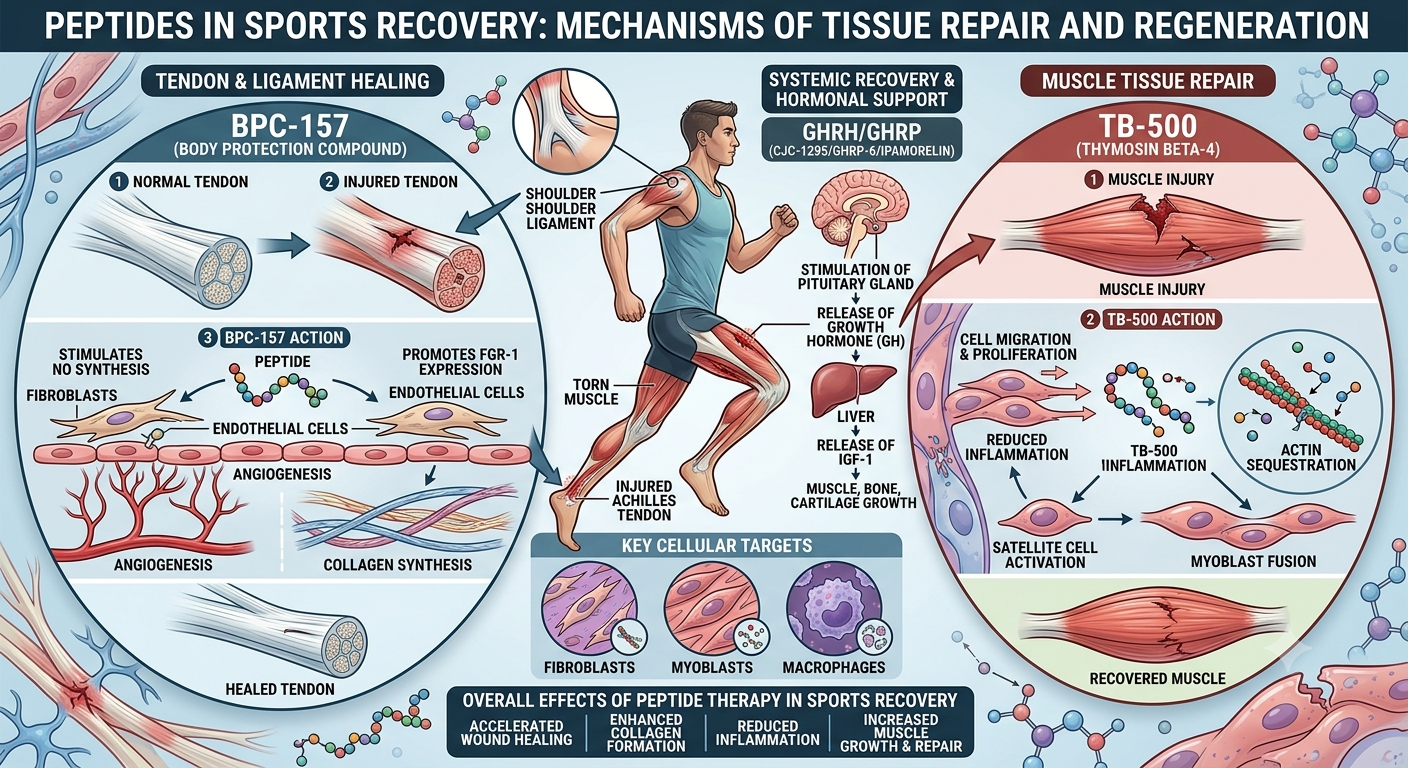
Injectable regenerative peptides like BPC-157 (Body Protection Compound-157) and thymosin derivatives are where the hype really takes off—and the science gets thin.
BPC-157 has shown significant promise in preclinical (animal) models. Research in rodents demonstrates accelerated healing of tendons, ligaments, and muscles through enhanced fibroblast proliferation, collagen synthesis, and angiogenesis . It appears to improve myotendinous junction healing and restore muscle function even after traumatic injuries or corticosteroid application .
A 2026 structured narrative review in JBJS Reviews categorized BPC-157, growth hormone axis secretagogues (like CJC-1295 and ipamorelin), and other regenerative peptides as “investigational” with “uncertain safety profiles, product quality concerns, and widespread antidoping restrictions” .
The review’s conclusion is worth quoting directly: “Injectable peptides for sports medicine remain largely experimental. Clinical use should be confined to approved metabolic agents for indicated conditions and to rigorously designed research protocols” .
Novel Research: The Future of Peptide-Based Therapies
Recent research points to promising developments beyond standard collagen and BPC-157:
A 2025 study identified five novel peptides from ovalbumin (egg white protein) that promote muscle repair through the PI3K-Akt-mTOR signaling pathway—the same pathway involved in muscle protein synthesis . One peptide, SK-10, significantly increased viability of damaged muscle cells and restored inflammatory markers to normal levels in lab models .
Another 2026 study introduced a micropeptide-inspired stapled peptide loaded in a hydrogel platform that demonstrated “potent regenerative capacity at nanomolar concentrations” with enhanced stability . A 2025 peptide liquid crystal hydrogel with aligned microstructure directed myoblast alignment and potentiated muscle functional recovery in rat models .
These are genuinely exciting developments—but they’re years away from human application.
What Athletes Need to Know
The Regulatory Landscape
BPC-157 is currently banned by WADA under the S0 Unapproved Substances category and named by the FDA as a Category 2 bulk drug substance . This means it cannot be compounded commercially, and there’s insufficient evidence on whether it would cause harm to humans. Professional and collegiate sports leagues in the U.S. have also banned its use .
Products marketed as BPC-157 are often sold as “research chemicals” or “dietary supplements,” classifications not subject to FDA regulations . This means quality, purity, and safety are entirely unregulated.
The Bottom Line
| Peptide Category | Evidence Level | Safety/Regulatory Status | Practical Takeaway |
|---|---|---|---|
| Collagen Peptides (Oral) | Moderate—meta-analyses show benefits with 15g/day for ≥8 weeks | Safe, widely available as dietary supplements | Evidence-based adjunct to training |
| BPC-157 | Preclinical only—animal studies show promise | WADA banned, FDA Category 2, unregulated products | Experimental; not for clinical use |
| Growth Hormone Secretagogues (CJC-1295, ipamorelin) | Investigational—no human trial support | WADA banned | Not supported by evidence |
| Novel Peptide Therapeutics | Preclinical—cell and animal models | Not approved for human use | Future potential, not current reality |
The hype around peptides for sports recovery is partially justified—collagen peptides, in particular, show measurable benefits when used consistently over time. But for injectable regenerative peptides like BPC-157, the gap between what’s being promoted and what’s actually proven is substantial. Athletes and practitioners should rely on evidence, not marketing, and stay within the bounds of both the science and the regulations that govern their sport.