Antimicrobial Peptides for Acne and Skin Infections: A New Hope Against Antibiotic Resistance
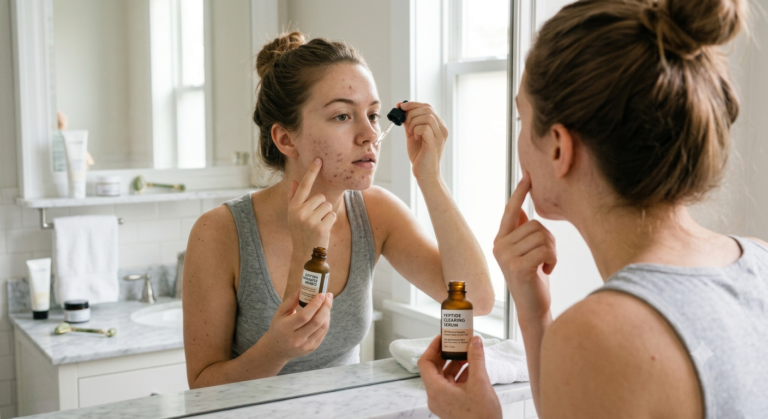
Acne isn’t just a teenage rite of passage. For millions of people worldwide, it’s a persistent, frustrating skin condition that can leave physical and emotional scars well into adulthood. And with antibiotic resistance on the rise, the standard treatments we’ve relied on for decades are becoming less effective. This is where a new class of compounds is stepping in: antimicrobial peptides (AMPs). These tiny warriors are being researched as a powerful new tool to combat acne and other skin infections.
The Problem: Why Current Acne Treatments Are Failing
Acne vulgaris is one of the most common skin conditions globally, affecting up to 85% of adolescents and young adults . While it’s not life-threatening, it can cause significant emotional distress, anxiety, and permanent scarring .
The primary culprit behind inflammatory acne is a bacterium called Cutibacterium acnes (formerly known as Propionibacterium acnes). For over 40 years, antibiotics like clindamycin have been the go-to treatment. But here’s the problem:
- Antibiotic resistance is skyrocketing: Over 50% of C. acnes strains are now resistant to common antibiotics, and antibiotic-resistant Staphylococcus epidermidis is also becoming more common in acne patients .
- Side effects are common: Topical retinoids, benzoyl peroxide, and salicylic acid cause skin irritation, dryness, and redness, while oral antibiotics come with more serious risks .
- Worse, they may be making the problem worse: The prolonged use of antibiotics for acne contributes to the emergence of multi-drug-resistant “superbugs,” creating a serious public health threat.
We desperately need new solutions—and this is where antimicrobial peptides come in.
What Are Antimicrobial Peptides?
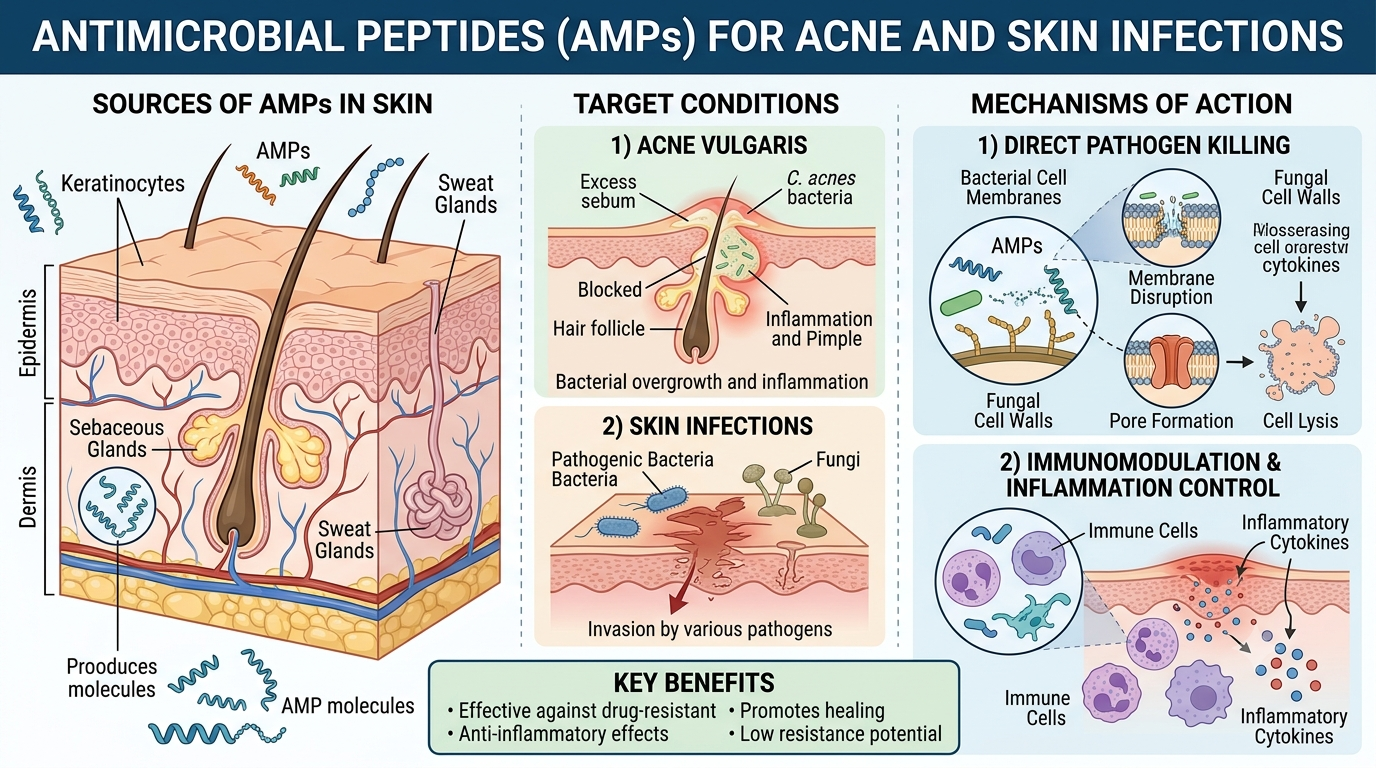
Antimicrobial peptides (AMPs) are small proteins that form a critical part of the immune system in all living organisms, from humans to plants and insects . In humans, they are produced by immune cells and the skin’s own epithelial cells . These peptides are part of what’s called the “innate immune response,” the first line of defense against invading pathogens .
Key characteristics of AMPs:
- Small and Mighty: They are typically short (12-50 amino acids) with a positive charge .
- Dual Action: AMPs have a positive charge, which allows them to be attracted to the negatively charged membranes of bacteria, much like a magnet . This selectivity means they can destroy bacterial cells without harming healthy human cells.
- Rapid and Physical Attack: Instead of targeting a specific protein as antibiotics do, AMPs physically destroy the bacterial cell membrane . This is a much faster and more comprehensive way to kill bacteria.
- Hard to Resist: Because they target the bacterial membrane in multiple ways, it’s much harder for bacteria to develop resistance compared to standard antibiotics .
How Do AMPs Fight Skin Infections?
The science of how AMPs work is fascinating and represents a significant shift from how traditional antibiotics operate. When AMPs come into contact with a bacterium, they can use several mechanisms to destroy it:
- Membrane Disruption:
- The Barrel-Stave Model: Peptides attach to the membrane and form a ring-shaped pore, causing the cell contents to leak out .
- The Toroidal Pore Model: Peptides insert into the membrane and bend it into a ring-shaped pore .
- The Carpet Model: Peptides cover the membrane surface like a carpet, eventually disrupting it in a “detergent-like” fashion .
- Intracellular Targeting: Some AMPs can cross the membrane and attack vital components inside the bacterium, such as its DNA or proteins .
- Immunomodulation: AMPs don’t just kill bacteria directly; they also act as “alarm signals,” coordinating the body’s broader immune response by recruiting immune cells and controlling inflammation .
Promising Research and New Developments
The potential of AMPs for treating acne and skin infections is not just theoretical. Numerous recent studies have shown significant breakthroughs:
Marine-Derived Peptides for Acne
Researchers have identified a peptide called Sph12-38, derived from a marine crab, that shows powerful activity against C. acnes. In a key study, it killed the bacteria at a very low concentration (minimum bactericidal concentration of 7 μM) without damaging human keratinocytes (skin cells) .
What makes this research even more exciting is how the peptide was delivered. When Sph12-38 was applied in combination with sponge spicules (tiny, needle-like structures that create micro-channels in the skin), penetration into the skin was enhanced by 6.1-fold, reaching the deeper layers where C. acnes resides . In a rabbit ear acne model, the combined treatment resulted in a 100% cure rate after two weeks, compared to 0% for the peptide alone .
Designed Peptides Against C. acnes
Scientists are also designing new peptides from scratch to be highly effective against C. acnes while being safe for human cells . By analyzing the structure of existing AMPs, they created a template for peptides that would be exceptionally active against the bacteria. Two of these designed peptides, DAP-7 and DAP-10, showed:
- Potent antimicrobial activity against both antibiotic-susceptible and -resistant strains of C. acnes.
- Minimal toxicity to human cells.
- The ability to reduce the expression of pro-inflammatory cytokines (the molecules that cause redness and swelling) .
In a mouse model, DAP-7 significantly reduced C. acnes colonies and alleviated ear swelling .
Broad-Spectrum Peptides for Skin Infections
Researchers have also designed a 10-amino acid peptide called KWKWAKRWWI, which has shown broad-spectrum activity against a range of pathogens, including multi-drug-resistant “superbugs” . When formulated into an ointment, it was highly effective at treating Staphylococcus aureus skin wound infections in mice, eliminating bacteria and accelerating healing .
The Challenges and The Future
Despite the immense promise, turning AMPs into over-the-counter treatments faces significant hurdles. These include:
- High Production Costs: AMPs are more expensive to produce than standard antibiotics.
- Stability: Many AMPs are easily broken down by enzymes in the body, limiting their effectiveness .
- Delivery: Getting these large molecules to the right place in the skin (like the deep sebaceous glands) is a challenge .
- Bacterial Resistance: While AMPs are less prone to resistance, studies have shown that bacteria can still develop resistance mechanisms against them, challenging earlier claims that they are “resistance-proof” .
These are significant hurdles, but researchers are actively working on them. While they aren’t available at your local pharmacy today, the research is a powerful sign that a new generation of treatments is on the horizon.
Read also